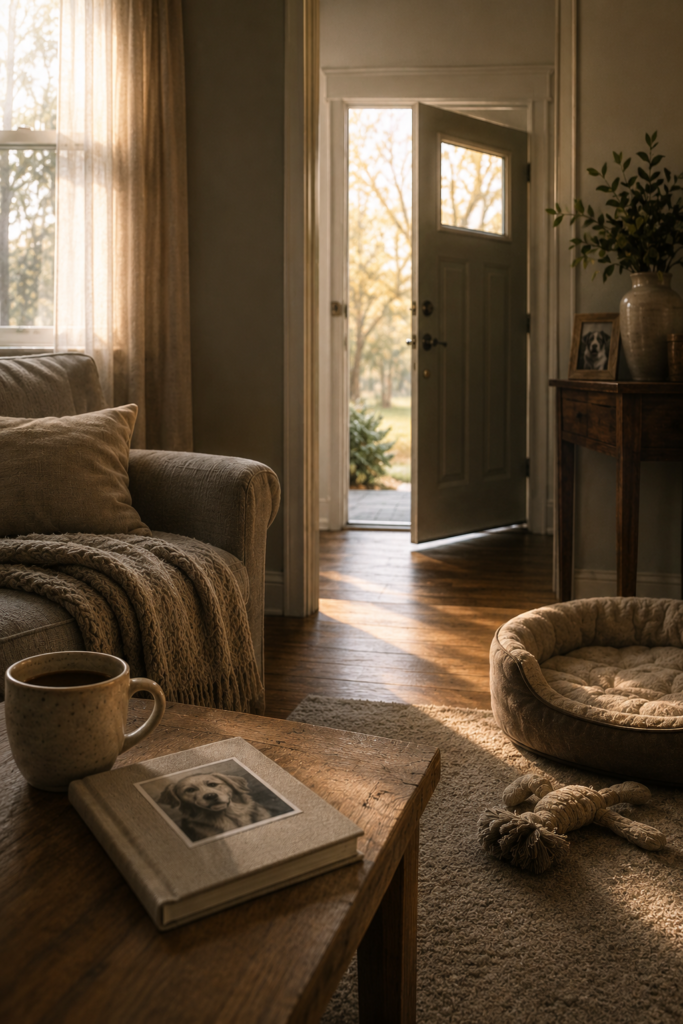
The silence after a pet is gone doesn’t feel like ordinary quiet. It feels like a room that’s holding its breath.
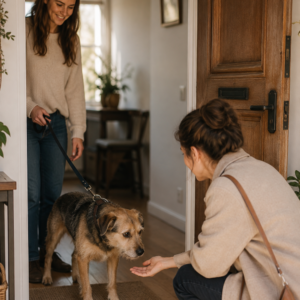
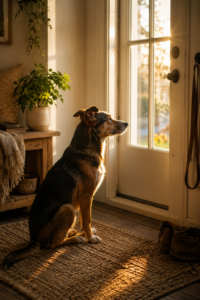
You notice it first in the doorway. The place where a body used to meet you, where nails would click against the floor before you’d even turned the key. Now there’s nothing—not a bad nothing, exactly, just an absence with a shape to it. A silence that used to have weight, and doesn’t anymore.
This is the last piece of a short series about the quiet architecture of living with an animal — the favorite spot in a home, the everyday sounds that fade into the background, the smell a pet leaves behind in a house, and the schedule you never chose but lived by anyway. Each of those pieces was about presence—about how much of a home is quietly built around an animal without anyone deciding it should be. This one is about what happens when that presence is gone, and the house keeps standing there, holding the shape of it.
The Silence After a Pet Is Gone Has a Sound of Its Own
Grief has a strange relationship with sound. Most people expect it to feel like sadness, like tears, like a lump rising in the throat at unexpected moments. What they don’t expect is how much of it arrives through the ears—or rather, through their absence.
The silence after a pet is gone is loudest in the exact places their sounds used to live. The particular exhale before sleep. The rhythm of a jump landing on a windowsill. The tag hitting a water bowl at three in the morning. These weren’t sounds you consciously tracked while your pet was alive—they were simply part of the texture of being home. It’s only once they stop that you realize how much of “home” was actually them.
There’s a term for this in psychology: absence perception. The brain doesn’t just register what’s missing—it actively searches for it, the way a tongue keeps finding the space where a tooth used to be. Researchers have found that our brains continue predicting familiar events long after they’ve stopped happening. For weeks, sometimes months, you may find yourself listening for a sound that will never come again. Not because you’ve forgotten they’re gone, but because your nervous system hasn’t caught up to what your mind already knows. It takes time for a body to unlearn a rhythm it built over years.
Why the Quiet Feels Like It’s Watching You
There’s a particular kind of silence after a pet is gone that doesn’t feel neutral. It feels almost active—like it’s aware of itself, aware of what it replaced.
Part of this is simple conditioning. If you spent years responding to small sounds—a whine at the door, a bell on a collar, claws on hardwood—your body built pathways around alertness. You were always half-listening, even when you didn’t know it. Now those pathways have nothing to fire on. The listening continues, but it finds nothing, and that mismatch is what makes silence feel less like peace and more like waiting.
This is also why so many people describe the days right after loss as unbearably long, even when nothing eventful happens in them. Time doesn’t move differently—but a home that used to be full of small interruptions now has none, and unstructured time has a way of expanding to fill exactly the space grief needs. A morning that used to be shaped by feeding times and short walks now stretches out with nothing to organize it, and that shapelessness can feel heavier than any single sad moment.
Some people try to fill this kind of quiet right away—with noise, with errands, with anything that mimics the old rhythm. Others can’t stand to touch it and let the house stay still for a long while. Neither response is wrong. Both are ways of coping with a silence that arrived without warning and doesn’t come with instructions.
The First Time You Notice You’ve Stopped Listening For Them
At some point—and it’s different for everyone—the silence after a pet is gone starts to change. Not because it fills back up, but because you stop straining against it.
This shift is often small enough to go unnoticed until it’s already happened. You walk into the kitchen and don’t flinch at the quiet. You sit down in the evening and your hand doesn’t drift, out of habit, toward a space on the couch that’s no longer occupied. It isn’t that you’ve forgotten. It’s that your body has slowly stopped expecting.
Some people feel guilty about this moment, as if a quieter grief means a smaller love. It doesn’t. It means the nervous system has done what nervous systems do—adapt, because adaptation is how living beings survive loss and keep living. Guilt tends to show up here uninvited, whispering that moving through the silence more easily is a kind of forgetting. It isn’t. Forgetting would mean the silence stops meaning anything at all. What’s actually happening is quieter than that: the silence stops being the loudest thing in the room and starts becoming simply part of the room.
What the Silence After a Pet Is Gone Eventually Becomes
There’s an odd turning point that a lot of people describe but rarely talk about out loud: the day the silence after a pet is gone stops being about what’s missing and starts being, simply, quiet. Not a wound. Just quiet.
This doesn’t happen on a schedule, and it isn’t a single decision. It happens in fragments—a morning where you make coffee without pausing at an empty bowl, an evening where the quiet feels almost restful instead of raw. Slowly, the home reorganizes itself around what’s actually there instead of what used to be. This isn’t the silence forgetting your pet. It’s the silence finally becoming yours again, instead of theirs.
Some people choose to fill that quiet eventually—with another animal, with new routines, with small deliberate changes to a room that used to belong to someone else. Others let the silence stay for a long while, and that’s its own valid way through. There’s no timeline that makes one version of this right and the other wrong. What matters more than the pace is that the house, in its own time, starts to sound like your life again—not empty, not exactly the same as before, but unmistakably yours.
When Other Sounds in the House Suddenly Feel Too Loud
One of the most surprising parts of grief is that the house doesn’t become silent—it becomes louder in completely unexpected ways.
The hum of the refrigerator. A clock ticking in another room. Your own footsteps on the floor where paws used to move beside them.
This isn’t really about volume. It’s about attention. For years, a large share of your listening was pointed toward one particular set of sounds—the ones your pet made. Now that attention has nowhere to land, so it drifts, and it lands on whatever’s left. Ordinary household noise starts to feel oddly intrusive, not because it changed, but because the quiet around it changed first.
If you share your home with other people, or other animals, this can be confusing for everyone. A partner’s normal evening habits might suddenly feel too loud, too careless, too unaware of the specific silence you’re sitting inside. It rarely has anything to do with them. It’s the sound of your own listening, still recalibrating to a house that lost one of its voices.
If you’re in the earliest days of losing a pet, you may also find comfort in reading about what grief often feels like at the beginning or why pet grief can be so unexpectedly overwhelming.
Questions People Often Carry
Is it normal for the silence to feel louder than the grief itself?
Yes. Many people say the quiet is harder to sit with than any single wave of sadness, because grief comes and goes, but silence is constant. It’s one of the most common and least talked-about parts of losing a pet.
Why do I still listen for sounds that will never happen again?
This is a normal, physical response, not a sign that you haven’t accepted the loss. The brain’s expectation systems take time to unlearn patterns built over years, and that adjustment happens on its own timeline, not on demand.
Does the silence after a pet is gone ever go back to feeling normal?
For most people, yes—though “normal” usually means something new, not a return to how things were before. The quiet tends to shift from feeling like absence to simply feeling like your home again, in its own time.
Is it okay if I’m not ready to fill the silence with another pet?
Completely. There’s no required timeline for that decision, and choosing to let a home stay quiet for a while is just as valid as choosing to bring in new sound sooner.
The quietest rooms are the ones that remember the most.