
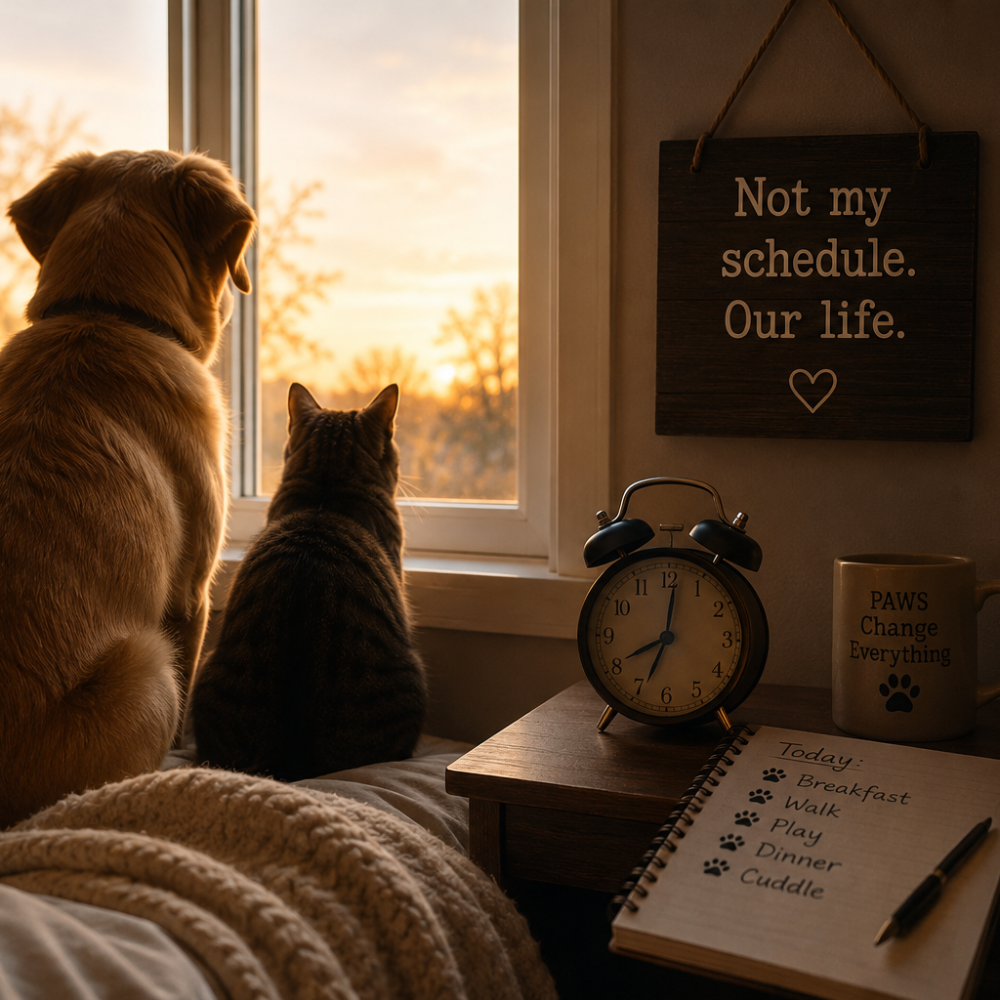
You didn’t sit down and plan your pet’s daily schedule. There was no calendar invite, no conversation about hours. And yet, somewhere in the first few weeks of sharing your home with a pet, a schedule formed — quietly, without asking permission, and now it shapes your day more than you’d probably admit.
A Rhythm That Wasn’t Yours to Begin With
Before your pet, mornings were negotiable. You could sleep in on a Saturday, skip breakfast, work late without a second thought. Now there’s a window — 6:40, maybe 6:45 — when a certain weight settles on the bed, or a familiar sound starts at the door. It isn’t loud. It doesn’t have to be. It’s simply consistent enough that your body has learned to expect it before your mind has caught up.
The same happens at the other end of the day. Dinner doesn’t shift by an hour anymore because someone is waiting, watching the kitchen with an attention that’s hard to ignore. Evening walks stop being optional exercise and become the last fixed point before the day is allowed to end. If you’ve noticed your pet’s favorite spot in the house shifting depending on the hour, that’s the same clock at work.
None of this was written down. It built itself, one small repetition at a time, until it stopped feeling like a rule and started feeling like simply how the day goes.
How Your Pet’s Daily Schedule Builds Without a Single Decision
What’s strange is that you can’t point to the moment it started. There was no announcement — no day where you thought, from now on, this is when we do this. It accumulated the way habits usually do: through small repetitions your pet gently insisted on, until the insisting wasn’t necessary anymore.
A cat doesn’t ask twice for its evening meal — it simply appears at the same spot, at the same time, until you’re the one glancing at the clock before it does. A dog doesn’t need to be reminded that a walk is due; it already knows, and lets you know it knows. Somewhere in that back-and-forth, your pet’s internal clock and yours quietly merged into one — not unlike the way you eventually stop hearing your pet’s everyday sounds once they become part of the background of a shared life.
You didn’t lose control of your day so much as you handed a piece of it over, in exchange for something that felt, at the time, like simply being a good pet owner. Eventually, something shifts. You find yourself waking a minute before the familiar sound. You reach for the food bowl before anyone reminds you. Your pet’s daily schedule has stopped belonging to one of you and started belonging to the household itself.
What Happens When the Schedule Breaks
The clearest proof of how real this rhythm is shows up when it’s interrupted. A late meeting. A weekend away. A morning when you oversleep by twenty minutes. The disruption doesn’t just affect your pet — it unsettles something in you, too.
There’s a particular kind of guilt that comes from being the reason a routine broke, even when the reason was reasonable. You catch yourself apologizing out loud to an animal that can’t understand the words, only the tone. And when the schedule resumes the next day, there’s a small, unspoken relief on both sides — as if something had been checked and found to still be in place.
That reaction is a clue. Schedules built around obligation rarely produce guilt when they slip. This one does, because somewhere along the way it stopped being obligation and became relationship. Veterinary behaviorists point to this same internal clock when explaining why animals thrive on predictable daily routines — consistency isn’t just a preference, it’s part of how they feel safe.
Your Pet’s Daily Schedule Is the Relationship, Wearing a Different Name
It’s tempting to think of a pet’s routine as a set of chores — feeding times, walk times, the mechanics of care. But look closer, and the schedule is really a record of attention. Every fixed point in the day is a moment where you and your pet show up for each other, on time, without needing to be asked twice.
That’s why your pet’s daily schedule doesn’t feel like a burden most days, even though you never chose it in the way you choose other commitments. It was built out of repeated acts of noticing — theirs of you, and eventually, yours of them. What looks from the outside like a rigid routine is, from the inside, one of the steadiest forms of companionship a day can hold.
Questions People Often Carry
Did I create this schedule, or did my pet?
Neither, entirely. Most pet routines form through a quiet back-and-forth — a pet repeating a need until it’s recognized, and their person responding until the response becomes automatic. It’s built together, even if it never feels like a decision.
Is it normal to feel guilty about breaking the routine?
Yes, and it’s usually a sign of how much the routine has come to matter, not a sign that something is wrong. Pets adapt more easily to occasional changes than the guilt suggests — the discomfort is often more about you than about them.
Should I try to make my pet’s schedule more flexible?
A little flexibility can help both of you handle disruptions with less stress, but there’s no need to dismantle a routine that’s working. Consistency is one of the things that helps pets feel secure in a home.
Why does this routine feel different from other daily obligations?
Most schedules are built around tasks. This one is built around another living being noticing you, and you noticing them back — which is closer to relationship than routine, even when it looks like one from the outside.
A schedule you never chose is often one of the truest signs of a life shared well.