
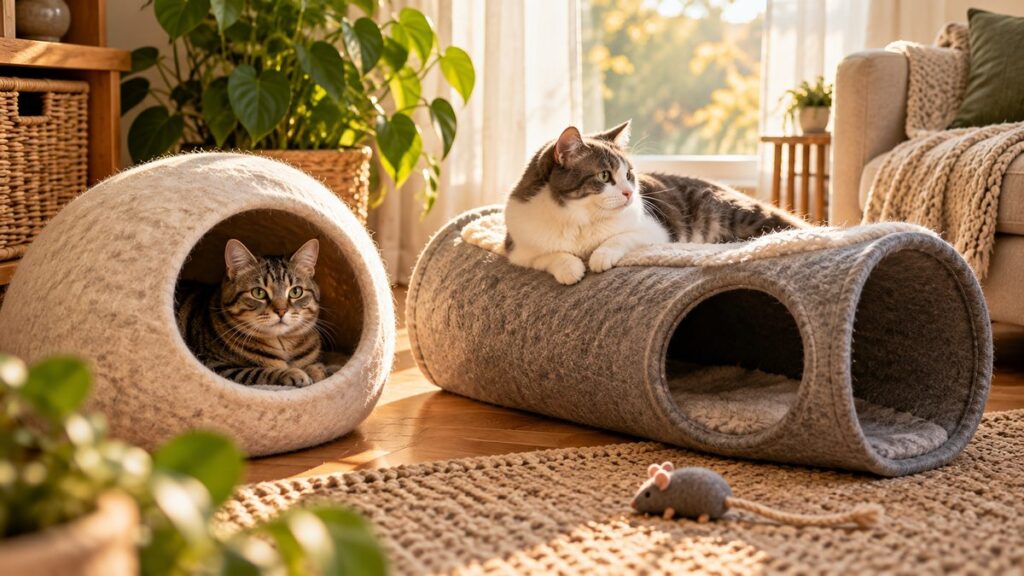
Cat cave vs cat tunnel bed looks like a small decision until you watch your cat choose between two things that were meant to be the same. One is a rounded, enclosed shape with a single opening. The other has a space underneath and a surface on top. They are both called a cat bed, and they answer very different questions.
Start with what your cat does when they want to be left alone
Before you compare anything, notice where your cat goes when the house gets loud, or when they are tired, or when they simply want to be elsewhere. Some cats fold themselves into the smallest space they can find: a cardboard box, the gap between the sofa and the wall, the bottom shelf of a cupboard that was left open. Others choose a high place instead, the back of the armchair, the top of the wardrobe, the windowsill, and they sleep there with one eye on the room.
Neither habit is a quirk. It is the way your cat feels safe, and a good bed is only a more comfortable version of the place they have already chosen.
What a cat cave is really for
A cat cave is built around enclosure. It has walls on every side and one way in, which means a cat inside it cannot be approached from behind and cannot be seen from across the room. For a cat who disappears under the bed when visitors arrive, that is the whole appeal.
A felt cat cave adds something else. Felt made from natural merino wool holds warmth and has a soft, dense feel, and the rounded shape lets a cat curl into it the way they would curl into a hollow. It suits cats who burrow, who push their way under blankets and who sleep with their face tucked in.
It is less suited to a cat who likes to see what is happening. A cave is a place to withdraw, not a place to watch from.
What a tunnel bed adds
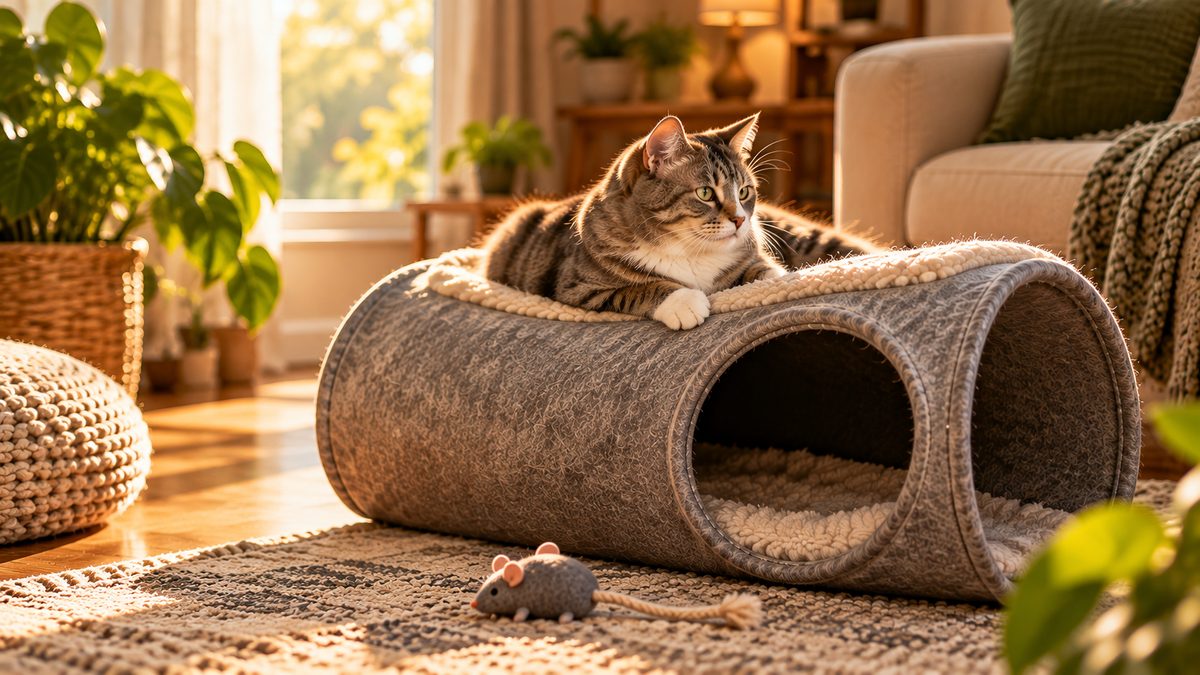
A peekaboo tunnel bed is a different idea. It has a hidden space underneath and a raised, cushioned surface on top, so one piece of furniture answers two moods. On a quiet afternoon your cat can lie on top and watch the room. When something startles them, they can drop inside and vanish.
That makes it a good choice for a cat who cannot decide, and most cats cannot decide, because their mood changes with the hour. The top gives them a view. The inside gives them a door they can close behind them.
It also suits a playful cat. The opening invites them to pop in and out, which a cave, with its single quiet entrance, tends not to.
The cat who hides and the cat who watches
If you want a simple way to choose, ask which of these sounds more like your cat.
A cat who hides will usually do better in a cave. Look for the cat who goes under blankets, into bags and into boxes, who sleeps with their back against something and who is hard to find in the afternoon. Give this cat a closed shape, and put it somewhere calm.
A cat who watches will usually do better with a tunnel bed. Look for the cat who sits on the back of the sofa, follows you from room to room and likes to be where something is going on. This cat wants a perch, with a retreat underneath for the moments they do not.
Many cats are a little of both. If yours is, the tunnel bed is the more forgiving choice, because it does not ask them to decide in advance which cat they are today.
If you have more than one cat
Two cats rarely want the same spot, and the cat who arrives second to a good bed often loses it. A larger four-cave tunnel bed gives each cat an entrance of their own, so nobody has to negotiate. It is worth thinking about this before you buy one small bed and wait to see who claims it.
How to introduce a new bed
Cats do not take well to being shown where to sleep. Put the new bed near the place they already use, not in a spare room, and let it sit there for a few days. If you have a blanket or a cushion they already like, place it inside so the bed smells familiar.
Then leave it alone. Do not lift your cat into it, and do not move it every time they pass it by. Most cats will inspect it when nobody is looking, and the first sign it has worked is usually a few hairs on the inside.
A small note before you buy
Some of the links on this page are affiliate links, which means we may earn a small commission if you buy through them, at no extra cost to you. We only link to things we would be glad to see in your home. If you would like to see more options in one place, the Gifts for Pet Lovers page gathers them.
Questions People Often Carry
Is a cat cave or a tunnel bed better for a shy cat? A shy cat usually wants somewhere closed and quiet, so a cave is the natural first choice. A tunnel bed can work too if the hidden space is the part they use, and you place it somewhere out of the way.
Will my cat use a cat cave if she already sleeps in boxes? Often yes. A cat who loves boxes is telling you she likes enclosure, and a cave is a softer, warmer version of the same thing. It still takes a few days of leaving it alone before she decides.
Is a tunnel bed too big for a small apartment? It takes more floor space than a cave, so measure the spot first. Placing it against a wall or beside the sofa, where a cat would already choose to sleep, usually works better than leaving it in the middle of the room.
In this series
This is the second article in our series about the places our pets sleep. In the first article, how to choose a pet bed, we started with how to read where your pet already sleeps. Next we look at beds for older dogs, donut beds and cooling beds for summer, and we finish with how a pet’s sleeping spot becomes something worth writing down in a pet memory journal.
“The best bed is usually the one that looks like the place they already chose.”