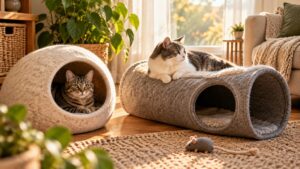
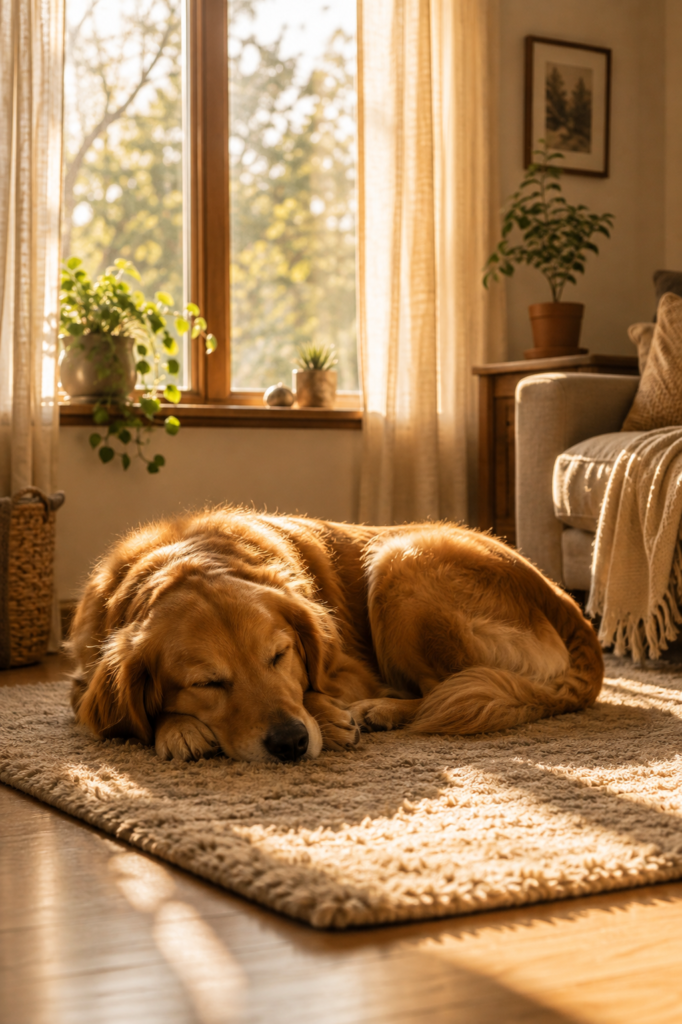
Watching your pet do nothing is one of the strangest, quietest pleasures of sharing a home with an animal. There is a particular stillness that settles over a room when a dog is asleep in a patch of sunlight, or a cat has folded itself into some improbable shape on a windowsill. Nothing is happening, and somehow that becomes the interesting part.
It can feel like the least productive way to spend a few minutes. Yet those small pauses can also feel surprisingly restorative. Your attention stops moving quite so quickly. For a moment, there is nothing to solve, answer, finish, or remember.
Maybe that is part of the comfort. The animal isn’t asking the moment to become anything more than it already is.
Why Watching Your Pet Do Nothing Isn’t Actually Nothing
It is easy to dismiss these moments as idle time — a pause between things that supposedly matter more. But research into mindful attention around companion animals suggests there may be something meaningful happening during them.
A 2025 study published in Scientific Reports examined mindfulness activated in the presence of a dog and found associations between greater mindful engagement with a dog and better psychological well-being. The researchers distinguished between simply having a dog nearby and the quality of attention directed toward that relationship. You can read the study in Scientific Reports.
That distinction is interesting.
A pet can spend an entire evening in the same room while your attention moves between a phone, television, work, and everything waiting for tomorrow. Physically sharing a space isn’t necessarily the same experience as actually noticing the animal sharing it with you.
This same quiet attention may be part of why people talk to their pets as though they understand every word. Much of companionship with an animal happens without anything particularly dramatic taking place.
Sometimes attention itself is the interaction.
What Makes an Animal So Easy to Watch
A sleeping dog doesn’t appear to be in a hurry.
A cat stretched across a windowsill isn’t visibly planning what needs to happen next. There is no phone being checked, no list being mentally rearranged, no obvious effort to make the next five minutes useful.
Of course, we can’t know that an animal experiences the present moment in the philosophical way humans mean when we talk about mindfulness. Pets have memories, expectations, motivations, and their own forms of attention.
But from the outside, their stillness can offer something remarkably uncomplicated to observe.
Breathing.
An ear twitching at a distant sound.
A paw shifting slightly in sleep.
Eyes opening for a second and closing again.
Watching your pet do nothing gives the mind somewhere gentle to rest its attention without requiring a story to follow.
And perhaps that’s enough.
There’s a reason dogs so often choose a spot like a soft, round bed over the sofa itself — comfort, but also something that feels entirely their own to disappear into.
Why This Feels Different From Other Kinds of Rest
A surprising amount of what we call rest still gives the brain something to process.
A television show has a plot. Social media provides an endless stream of tiny decisions about what deserves another second of attention. Even a podcast requires following someone else’s thoughts.
None of those things is necessarily bad. They simply aren’t the same kind of pause.
Watching an animal rest asks very little in return.
There is no ending to reach and no information you need to retain. If your attention wanders and returns thirty seconds later, you haven’t missed anything important.
Research on human-animal interaction has repeatedly explored potential relationships between interactions with companion animals and measures of stress, anxiety, and well-being, although results vary depending on the population, setting, and type of interaction being studied.
That makes it worth resisting an overly neat claim that simply looking at a sleeping pet automatically reduces stress.
The experience is subtler than that.
For many people, it simply creates an unusually easy opportunity to stop directing attention toward everything else.
The Small Details You Start to Notice While Watching Your Pet Do Nothing
Stay for another moment and the scene stops being completely still.
The dog’s breathing has a rhythm.
A whisker moves.
The cat’s paw curls slightly inward.
An ear turns toward a sound that you barely registered yourself.
These details are insignificant in almost every practical sense, which may be exactly why noticing them feels different from paying attention to most other things.
Nothing needs to be done with the information.
You don’t have to remember it.
You don’t have to respond.
You only noticed.
This is one of the quieter ways living with a pet can change how you notice time. Animals create small pauses throughout a day that don’t fit neatly into minutes spent accomplishing something.
Sometimes the pause lasts only long enough to look across the room and realize that someone has fallen asleep in the sun.
Why Watching Your Pet Do Nothing Is Easy to Undervalue
There is nothing to show for these minutes afterward.
No walk has been completed. No photograph necessarily gets taken. No task gets crossed off a list.
From the outside, watching your pet do nothing looks suspiciously like doing nothing yourself.
That can make the moment surprisingly difficult to value.
We are generally better at legitimizing rest when it has a recognizable form. Reading a book counts. Going for a walk counts. Meditation certainly counts once an app has started measuring the minutes.
Standing in the kitchen for forty seconds because the afternoon light has fallen across your sleeping dog in a particularly peaceful way is harder to classify.
So it usually isn’t classified at all.
It simply happens.
And then the day continues.
Perhaps not every restorative moment needs to become a habit, technique, or wellness practice. Turning these pauses into another thing we are supposed to do correctly would almost defeat their charm.
They matter partly because nobody scheduled them.
When Looking Turns Into Watching
Most people who live with an animal probably glance at them countless times throughout the day.
A dog asleep beside a desk.
A cat washing its face.
A rabbit stretched comfortably in its enclosure.
Usually the eyes move on almost immediately.
But occasionally the glance lasts.
You notice the rise and fall of breathing. The ridiculous position of one paw. The tiny movement that accompanies a dream you will never know anything about.
The difference between looking and watching may be only a few seconds of attention.
That doesn’t mean those seconds have to produce a measurable psychological benefit to be worthwhile.
The moment can simply be pleasant.
There is something refreshing about allowing that to be enough.
The Comfort of Being Needed for Nothing
Perhaps there is another reason these moments feel different from more active parts of living with an animal.
Much of pet care involves responsibility.
Food needs preparing. Water needs changing. Walks happen in rain as well as sunshine. There are medications, appointments, litter boxes, grooming, muddy paws, unexpected expenses, and routines that continue whether or not the person responsible feels energetic that day.
Then, occasionally, everything is done.
The animal is fed.
The room is quiet.
Nobody needs anything.
A dog sleeps with its head against the sofa. A cat watches dust move through a strip of sunlight and eventually closes its eyes.
For a few minutes, companionship asks for absolutely nothing.
No care needs to be performed.
You only get to be there.
Maybe that is the weird comfort hidden inside watching your pet do nothing.
Not every expression of a relationship has to involve doing something for each other.
Sometimes sharing the same quiet room is the whole event.
Questions People Often Carry
Is there research showing that paying attention to a pet can affect well-being?
Yes. Research into human-animal interaction and pet-related mindfulness has found associations between attentive engagement with companion animals and aspects of psychological well-being. The evidence doesn’t mean that simply watching a pet will have the same effect for every person, but it supports studying the quality of attention rather than presence alone.
Do I have to pet or play with my animal for the moment to be calming?
Not necessarily. Direct interaction and simply observing an animal are different experiences. If quietly watching your pet helps your attention settle for a moment, the experience doesn’t need to become active interaction to be worthwhile.
Why can watching my pet sleep feel more restful than watching television?
One possible reason is that there is almost nothing to follow. A sleeping animal offers movement and sensory detail without requiring you to track a narrative or process a stream of new information.
Is watching my pet a form of mindfulness?
It can resemble mindful attention when you deliberately notice what is happening in the present moment without trying to change it. It doesn’t need to be treated as a formal mindfulness exercise, though. Sometimes watching your dog sleep can simply be watching your dog sleep.
Some of the best rest doesn’t look like rest at all. It looks like watching someone else do absolutely nothing.