
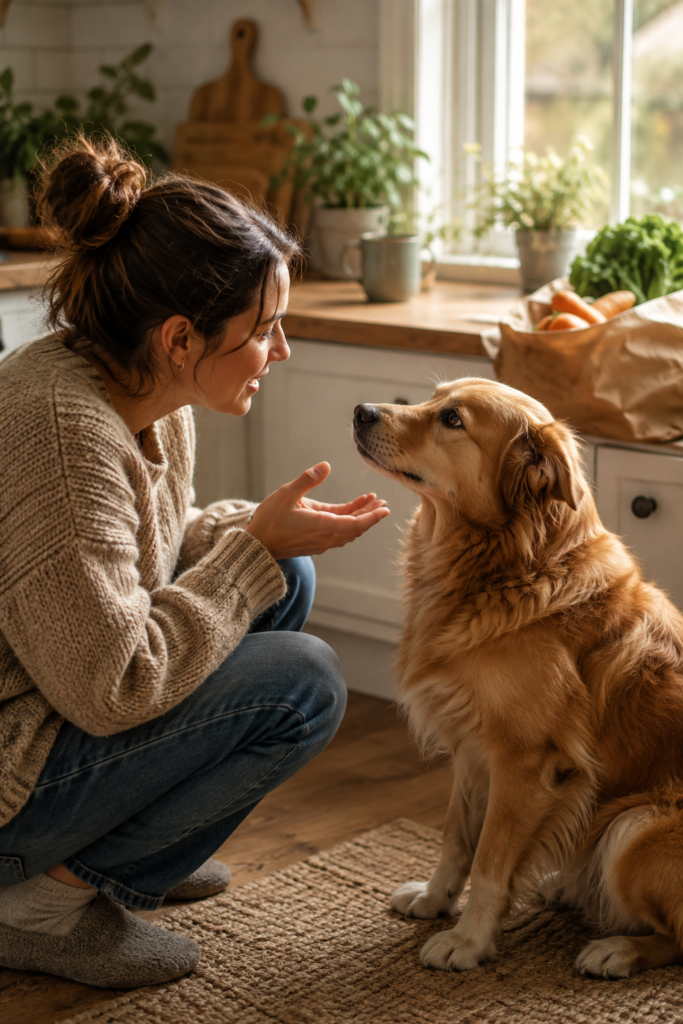
It usually starts small. You narrate what you’re doing while you unpack groceries. You ask, out loud, what they think about the weather. You catch yourself explaining why you’re in a bad mood, as if an explanation were owed. Talking to your pet like they understand every word becomes so natural that you stop noticing you’re doing it—until a guest catches you mid-sentence, and you have to decide whether to feel embarrassed or simply smile.
Almost everyone who shares a home with an animal ends up doing this eventually, in one form or another. Not baby talk exactly, though that often creeps in too, but a genuine, sentence-by-sentence narration of everyday life, offered to someone who can’t answer in words and never needs to. Somewhere along the way, it simply becomes part of living together. Which makes you wonder: why does it feel so natural in the first place?
Talking to Your Pet Like They Understand Is More Common Than You’d Think
If you’ve ever felt a flicker of self-consciousness after catching yourself mid-conversation with an animal, it helps to know how common this really is. Nearly everyone who lives with a pet ends up talking to them like they understand—full sentences, genuine questions, even the occasional pause as though a reply might be coming.
Psychologists call the underlying tendency anthropomorphism: attributing human thoughts, feelings, or intentions to non-human beings. It’s the same mental ability that helps us read another person’s emotions from their expression or tone of voice, naturally extending toward the animals we live with. As Psychology Today explains, anthropomorphism is widely regarded as a normal—and often useful—part of human social cognition, rather than a sign that someone has blurred the line between people and animals.
That perspective matters, because for a long time this habit carried a quiet sense of embarrassment. Talking to a pet like they understand every word was often treated as something childish, a habit people were expected to outgrow. Today’s understanding suggests something quite different. It isn’t a lapse in judgment at all—it may simply be one of the many ways humans naturally build connection.
Why It Doesn’t Feel Strange From the Inside
From the outside, narrating your grocery unpacking to a supervising cat might look slightly ridiculous. From the inside, it almost never feels that way. Talking to your pet like they understand every word feels less like performing and more like having company—a simple way of making an ordinary room feel shared instead of empty.
Part of that comes down to what speaking aloud actually does. Saying something out loud, even to a listener who can’t answer, is different from silently thinking it. Explaining your day to a dog asks you to shape scattered thoughts into complete sentences, giving feelings that were previously vague a beginning, a middle, and an end. That’s not a meaningless exercise. It’s a quiet form of reflection, one that often makes difficult thoughts feel just a little easier to carry.
There’s also the matter of the audience. A pet won’t interrupt, correct your grammar, or wait impatiently for their turn to speak. They offer something surprisingly rare: a listener with no opinion about what you’re saying, only about whether you’re close enough to reach. That absence of judgment is one of the reasons the habit lasts. Few conversations ask so little of us while giving us such a strong feeling of companionship.
Why Talking to Your Pet Like They Understand Reveals the Relationship
Talking to your pet like they understand every word isn’t really about the words themselves. It’s about proximity, attention, and belonging. You don’t narrate your life to furniture. You narrate it to someone who has quietly become part of your everyday world, even if they can’t understand language in the way another person would.
That’s why the habit tends to grow stronger over time instead of fading away. In the beginning, most conversations are practical—commands, praise, reminders, the basic vocabulary of care. Gradually they become something else entirely. Commentary. Opinions. Confessions. You tell your dog about the disagreement you had at work. You ask your cat, half seriously, whether taking that new job would be a mistake. The topics change because the relationship has changed. Somewhere along the way, companionship quietly replaces simple ownership.
Research into anthropomorphism suggests that this doesn’t happen because people are missing human relationships. If anything, the tendency often develops alongside healthy social lives. Extending conversation toward an animal appears to be another expression of the same deeply social mind that helps us connect with other people. It isn’t a substitute for human connection. For many households, it’s simply another form of connection.
There’s another layer to the habit that rarely gets mentioned. For many people, talking to a pet also becomes a quiet form of self-soothing. Explaining a stressful situation aloud—even to a dog who’s paying far more attention to your tone than your words—can slow racing thoughts in a way silent worrying often can’t. The animal doesn’t need to follow the story. Their presence changes how the story feels, simply because it is being shared instead of carried alone.
The longer those conversations continue, the less they feel like a habit and the more they become part of the relationship itself.
When the Habit Changes Shape
Talking to your pet like they understand every word doesn’t stay the same. It shifts with your mood, with changing seasons of life, and with how much a particular day has asked of you.
On an ordinary evening, it might sound like idle narration—what’s for dinner, why the mail is late, a running commentary on nothing especially important. On a harder day, it becomes something closer to confession: the kind of sentence you might never say to another person, spoken aloud anyway because the room feels safe enough to hold it.
That’s part of what makes the habit so enduring. It doesn’t depend on your pet understanding every word for it to matter. What it needs is a listener who’s present, calm, and entirely uninterested in judging what you’ve said. Most pets offer exactly that without ever trying.
Many people notice the habit becoming even stronger during the quieter parts of the day—the kind of quiet that the objects around a house begin to fill in their own way. Conversation does something similar. It turns an empty kitchen into a shared one, even when only one of its two occupants is speaking.
What Changes When the Habit Becomes Two-Way
Given enough time, talking to your pet like they understand every word begins to feel far less one-sided than it technically is.
You start reading their posture, the position of their ears, the slight tilt of a head, as though each movement were part of the conversation. A dog’s contented sigh after you’ve finished talking can feel strangely like agreement. A cat’s slow blink can feel reassuring in a way words sometimes aren’t. None of these are language in the human sense, yet they often function like one—a quiet exchange of attention that satisfies something deeply real without requiring shared vocabulary.
Perhaps understanding every word was never the point. Feeling understood might be.
That’s one reason these conversations rarely feel lonely from the inside, even though only one voice is speaking in words. The pauses aren’t empty. They’re filled with attention, familiar routines, tiny gestures, and the quiet trust that grows naturally between two beings who have spent enough ordinary days together.
Perhaps that’s why those conversations never really feel one-sided, even when only one voice is using words.
Questions People Often Carry
Is it a sign of loneliness if I talk to my pet a lot?
Not necessarily. Research on anthropomorphism generally views this as a normal part of human social behavior rather than a sign of isolation. Many people who regularly talk to their pets also have rich, fulfilling relationships with family and friends.
Why do I use a different voice or tone when I talk to my pet?
Many people naturally switch into what’s known as pet-directed speech—a warmer tone, a slightly higher pitch, and simpler sentences. Research suggests this style of speaking tends to capture animals’ attention more effectively than everyday conversation.
Does my pet actually understand what I’m saying?
Most pets respond primarily to familiar words, tone of voice, body language, and repeated routines rather than complete sentences. Even so, the emotional exchange is genuine. Your calm voice, your attention, and your pet’s response all contribute to a real form of communication, even without shared language.
Should I be worried if I only talk this way when no one else is around?
Not at all. Many people reserve these conversations for quiet moments at home precisely because they feel private. A pet won’t interrupt, judge, or repeat what you’ve said. That sense of complete safety is often exactly what allows people to speak so openly.
Maybe that’s one of the quietest ways companionship changes a home. Long before we notice it, everyday thoughts stop staying inside our own heads and begin finding their way into ordinary conversations with someone who never needed words to become part of our life.
Some of the truest sentences in a house are the ones said out loud to someone who can’t talk back.