A pet changes how you notice time in ways that are easy to miss until you try to remember what your days looked like before. Mornings that once blurred together begin to take on a shape—a familiar hour when paws touch the floor, a stretch of sunlight across the window that quietly announces it’s almost time for a walk. Evenings develop their own gentle checkpoints. Somewhere along the way, the day stops feeling like an abstract stretch of hours and becomes something closer to a rhythm you can feel in your body.
It isn’t really the clock that changes. It’s the way your attention begins dividing the day. Before a pet, time may have passed in long, undifferentiated blocks: work, errands, sleep, repeat. Afterward, it becomes broken into smaller, richer moments, each one quietly marked by another living creature. Even the language people use begins to shift—“before dinner,” “after our walk,” “around nap time.” A private calendar, built entirely around someone else’s daily rhythm.
How a Pet Changes How You Notice Time Each Morning
The clearest example appears before you’re even fully awake. A pet changes how you notice time first thing in the morning, often before an alarm has the chance to. A cat pacing beside the bed. A dog’s nose gently nudging the blanket. These become their own kind of clock, one that runs on hunger, daylight, and familiar routines rather than numbers on a screen.
This isn’t simply your imagination. Animals build remarkably consistent daily rhythms around cues like feeding, light, and household activity. Once those rhythms become shared, they begin shaping your mornings just as much as theirs. A PetMD overview of canine time perception explains that dogs become highly attuned to predictable daily events such as meals, walks, and bedtime routines. Before long, your own mornings begin following the same quiet pattern, whether you ever intended them to or not.
Over time, something quieter happens. What begins as a gentle nudge at 6:45 slowly becomes an expectation your own body carries, even on mornings when your pet decides to sleep a little longer. You wake already sensing the hour before you’ve looked at the clock, because your own rhythm has gradually learned one that didn’t originally belong to you.
Why a Pet Changes How You Notice Time in Ordinary Hours
Beyond those obvious morning rituals, a pet changes how you notice time in much subtler ways throughout the day. An afternoon that might once have slipped by unnoticed now contains small landmarks—a walk, a meal, the quiet moment when an animal shifts into a patch of sunlight that’s slowly moving across the floor. None of these are major events. Yet they become the punctuation marks in a day that might otherwise run together without natural pauses.
It matters more than most people realize. Unstructured time has a way of feeling both empty and endless, especially on days when very little else demands your attention. A pet’s routine—however ordinary it seems—breaks that open space into smaller pieces you can actually feel passing. Instead of measuring an afternoon by the clock, you begin measuring it by the next familiar ritual: the next walk, the next meal, the next sleepy relocation to wherever the sunlight has wandered.
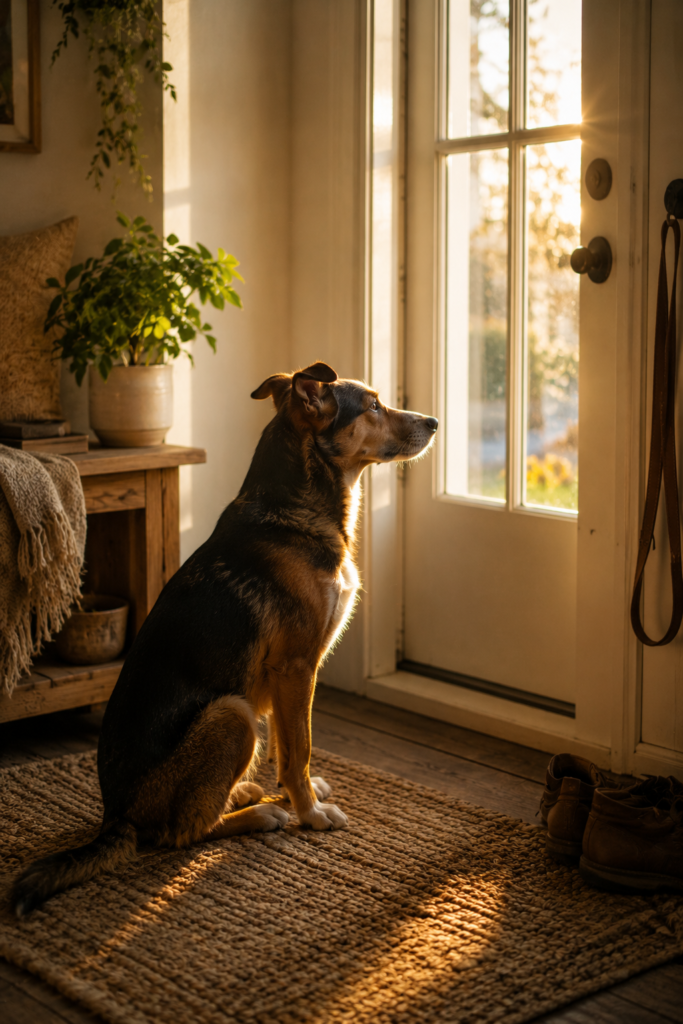
There’s also a quiet gift in the way animals notice light itself. Watching a dog follow a sunbeam across the floor over the course of an afternoon is its own gentle lesson in noticing time—not in minutes or hours, but in warmth, movement, and changing shadows. It’s a way of experiencing the day that many people gradually stop paying attention to as adults. Pets simply invite it back without ever meaning to.
The Way a Pet Changes How You Notice the Seasons
It isn’t only individual days that change. A pet changes how you notice time across weeks, months, and entire seasons as well.
Winter stops being just shorter days on a calendar. It becomes earlier evening walks, colder mornings, and a different rhythm inside the house once darkness arrives sooner. Spring announces itself through longer walks, open windows, and an energy that quietly returns to both the household and the animal moving through it.
These seasonal changes rarely arrive as conscious observations. You don’t decide to notice that summer evenings stretch walks later into the day or that autumn brings a certain restlessness before rain. You simply begin living by those patterns. A pet responds naturally to changing light, weather, and temperature, and before long, your attention begins following those same cues. The seasons stop being dates on a calendar and become something you experience together.
When Time With a Pet Starts to Feel Different Than Time Alone
There’s a particular kind of time that seems to exist only when an animal is nearby—unhurried, uncomplicated, and entirely rooted in the present moment. Watching a dog asleep in a patch of sunlight or a cat carefully grooming itself with complete indifference to the clock has a quiet way of slowing your own sense of urgency to match. A pet changes how you notice time not only by marking it, but by offering a different way of moving through it—one where an afternoon doesn’t have to be productive in order to feel meaningful.
That may be one reason so many people describe time spent with a pet as feeling fuller than time spent the same way alone. The minutes themselves aren’t different. What changes is your attention. An animal’s complete lack of urgency quietly gives you permission, if only for a little while, to stop measuring the day by everything that still needs to be done.
Much like the objects that quietly become theirs, certain hours of the day gradually become theirs too—not through ownership, but through repetition. A morning walk. An afternoon nap. The moment dinner is served. Eventually, those hours feel impossible to imagine without them.
What Happens to This Sense of Time During a Vacation or Absence
Perhaps the clearest proof of how deeply a pet changes how you notice time appears the moment that familiar rhythm disappears.
Spend a week away without your pet, and the days can begin to feel unexpectedly shapeless. Not because nothing is happening, but because the small moments that usually divide the hours simply aren’t there. No familiar footsteps at the bedroom door. No quiet reminder that it’s time for a walk. No tiny rituals separating morning from afternoon and afternoon from evening.
Coming home often restores that rhythm almost immediately. Within a day or two, the familiar landmarks quietly return—the same morning greeting, the same afternoon routine—and the day settles back into a shape that feels strangely comforting. It’s a gentle reminder that your sense of time was never built entirely on clocks. It was built together, one repeated moment after another.
The change isn’t only happening on your side, either. Pets notice these interruptions just as clearly, even if they experience them differently. Dogs don’t measure hours or days the way people do, but they become remarkably sensitive to changes in routine and daily patterns. A disrupted schedule may show itself through restlessness, changes in appetite, or an especially enthusiastic greeting when everything finally returns to normal.
Time didn’t become slower. It simply became easier to notice.
Questions People Often Carry
Do pets actually perceive time the way humans do?
Not exactly. Animals rely much more on routine, daylight, hunger, and familiar daily patterns than on clock time. Research suggests they anticipate events by recognizing repeated cues rather than counting hours.
Why does my dog seem to know when it’s almost time for a walk?
Dogs pay close attention to household routines. Changes in light, familiar sounds, your movements around the house, and other everyday signals all become reliable clues that something they expect is about to happen.
Is it normal for my sense of time to change once I got a pet?
Yes. Many people find that their days become more structured and more memorable after bringing a pet home. Daily routines create natural pauses that make time feel less like an uninterrupted blur and more like a series of shared moments.
Does this change if my pet’s routine shifts, like with a new work schedule?
Usually, yes. Pets gradually adapt to new household routines, and people often find themselves adjusting alongside them. Before long, both settle into a new rhythm that feels just as natural as the old one once did.
Maybe that’s one of the quietest gifts animals bring into our lives. They don’t give us more time. They simply teach us to notice the time we already have.
A pet doesn’t just share your home. It teaches your days where to put their pauses.