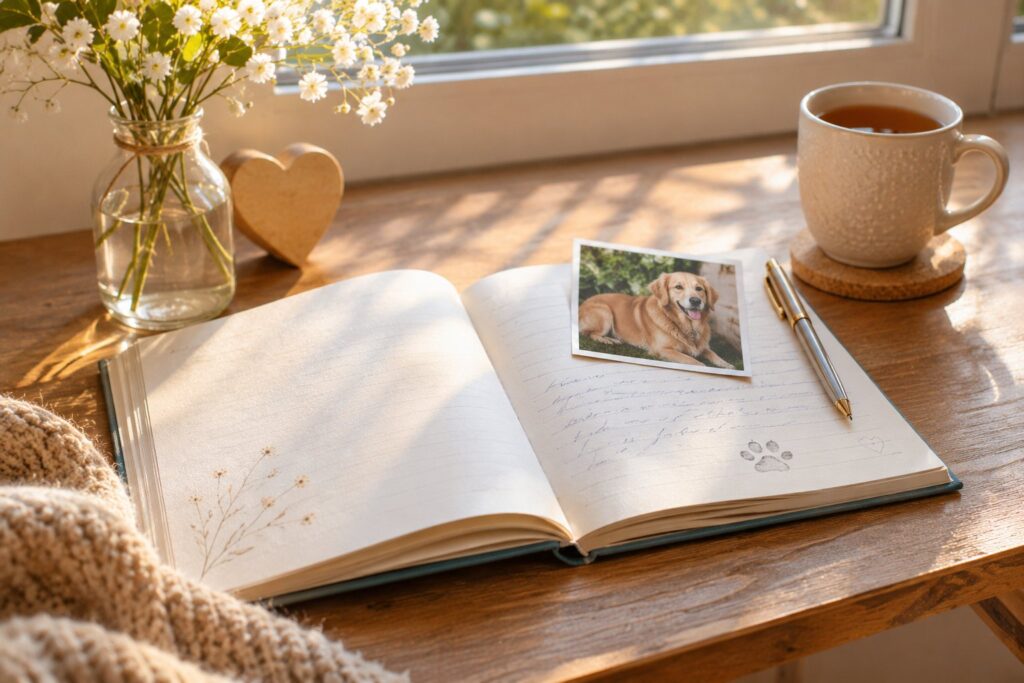
Short answer: A memory book for pet loss is a small, private book where you keep photos, habits and the little stories that made your pet who they were. You do not need to write well or finish it quickly. Start with one photo and three sentences, and add to it when you are ready.
Last updated: November 2026
When a pet dies, the first thing many people notice is how quiet the house is. The second thing is how fast the small details begin to blur: the sound they made at the door, the spot they chose in the afternoon, the way they asked for dinner. A memory book gives those details somewhere to go.
This guide covers what to put in a memory book for pet loss, how to begin when the page feels too heavy, and how to choose between a notebook you make yourself and a guided book.
Why a memory book can help
Grief for a pet is real, and it often has no ceremony and no one asking how you are. Writing things down will not make the loss smaller, but many people find it gives the feeling a shape. It also does something quieter: it keeps the ordinary details from fading, which are usually the ones you miss most.
A memory book is not a task and it is not therapy. It is a place to put what you do not want to lose.
What to put in a memory book for pet loss
There is no correct list. These are ideas that tend to work, because they are specific:
- Their name and the story of it. Who chose it, and was it ever shortened or changed?
- The first day. Where you met, what you noticed first, how they behaved on the way home.
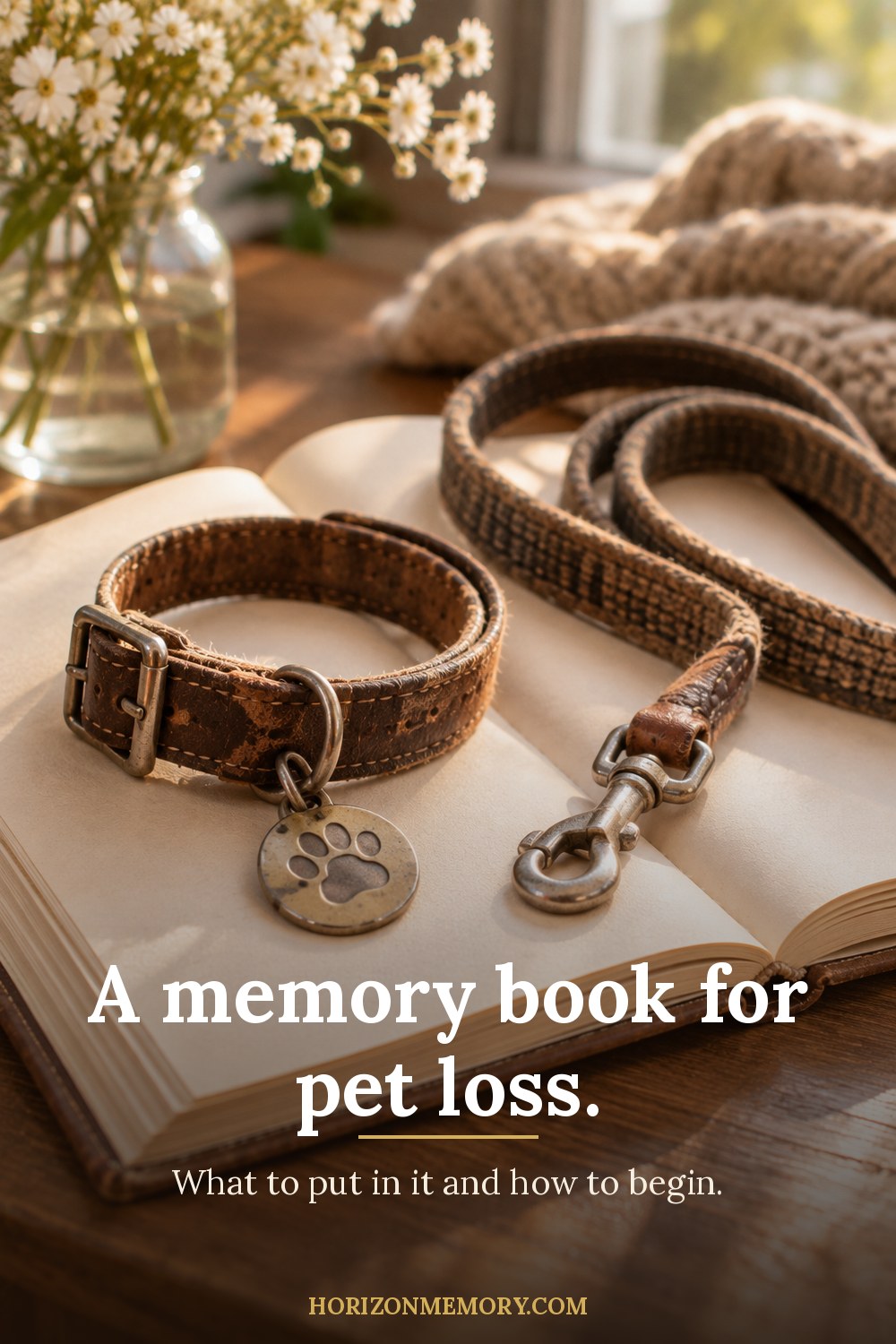
- Habits. How they greeted you, where they slept, what they did when the lead came out. These fade fastest.
- Favorites. The toy, the treat, the walk, the person, the window.
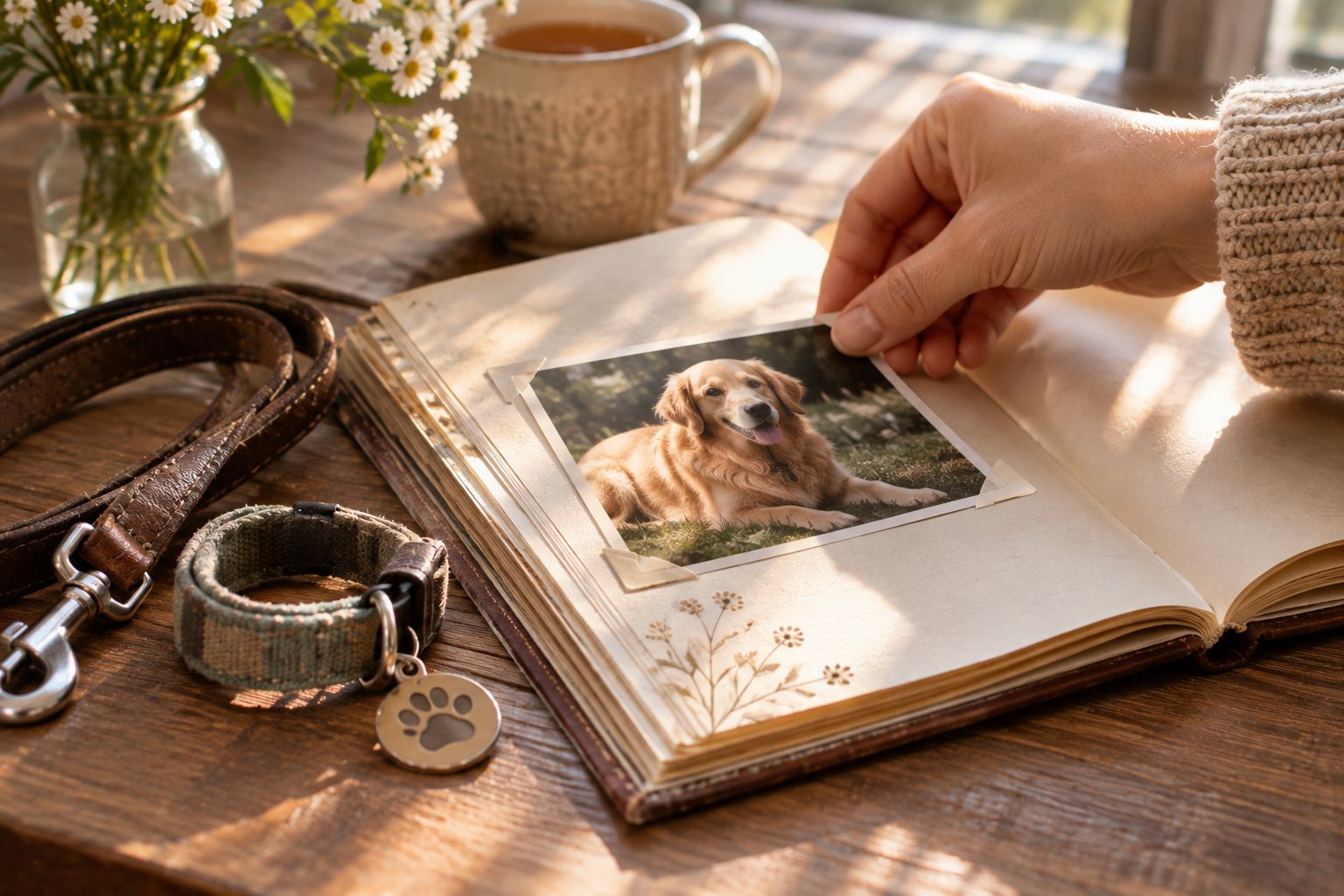
- Photos, including the ordinary ones. The blurry photo is often the one that says most.
- Things you used to say to them. Nicknames, phrases, the voice you used.
- A letter to them. Short is fine. Many people write one page and keep it for the end.
- What they taught you. About patience, routine, being noticed, or being quiet together.
- The last good day. If you want to write it, keep it factual first and add feeling later.
If you are not ready for the last pages, begin with the first day or a favorite habit. A memory book does not have to be written in order.
How to begin when the page feels too heavy
- Pick a quiet time and a small corner, not the whole afternoon.
- Choose one prompt from the list below, or one photo.
- Write three sentences. Stop if you want to.
- Date the page. Future you will be glad to know when it was written.
- Close the book and put it somewhere you can reach it.
Ten sentence starters
- The first thing I noticed about you was…
- When I came home, you always…
- Your favorite place in the house was…
- The sound I will always remember is…
- On a rainy day, you…
- You made me laugh when…
- The way you asked for dinner was…
- I never told anyone that you…
- What I want to remember most is…
- If I could tell you one thing, it would be…
Notebook, album or guided book?
Any of these can work. The right one is the one you will open.
| Option | Best for | Worth knowing |
|---|---|---|
| Blank notebook or scrapbook | People who like complete freedom | Can feel intimidating when the page is empty |
| Photo album | People whose memories are mostly pictures | Holds images, but not the habits and stories behind them |
| Guided memory book | People who find it hard to start | Prompts do part of the work; you still choose what to write |
| Digital folder or notes app | People who want to write at night or on the go | Easy to start, easier to lose; consider printing the best pages |
If you would like a guided option, our own Pet Memory Journal has guided prompts, room for photos, milestones and moments, and a keepsake page. It is something I made, so treat that as a disclosure rather than a recommendation: a notebook you already own is just as valid.
A small note
Writing can bring feelings up as well as set them down. If grief feels too heavy to carry alone, talking to someone you trust or to a professional can help. A memory book is a companion, not a replacement for that.
Frequently asked questions
How soon after losing a pet can I start a memory book?
Whenever it feels possible. Some people begin within days, others wait months or years. There is no right time, and a book started late is just as real as one started early.
Do I need to write well to make a memory book for pet loss?
No. Short, plain sentences are enough. A list of habits, a date, a place and a few words you used to say to them will matter more to you later than polished writing.
What if I start crying while I write?
That is common and it does not mean the book is a bad idea. Take a break, drink some water, and come back when you want to. Stopping mid-page is allowed.
Can I make one for a pet who died years ago?
Yes. Many people find that they remember more than they expected once they start, especially small things like the sound of the lead or where the pet waited. Write what you remember and leave gaps where you don’t.
Should I use a blank notebook or a guided book?
Either works. A blank notebook gives you complete freedom. A guided book gives you prompts, which helps if you stare at an empty page. Choose whichever you are more likely to open.
Is it okay to write directly to my pet?
Yes. Many people write in the second person, as a letter. It can feel more natural than writing about them in the past tense.
What photos should I include?
Include the ordinary ones as well as the good ones: the blurry photo at the door, the one taken from behind on a walk, the pet asleep in an odd spot. Those often hold the most memories.
Can children help with a pet memory book?
Yes, if they want to. Children often remember details adults forget, and drawing a picture or adding a favorite toy photo gives them a way to take part without needing the right words.
Related reading
- Why Writing It Down Helps — A Journal for the Grief You Can’t Say Out Loud
- Keeping Their Memory — Small, Meaningful Ways to Hold On
- The Last Good Day — A Piece for Anyone Who Had to Say Goodbye
Whatever you put in the book, it is yours. A few honest lines about the way they looked at you are worth more than a perfect page.