
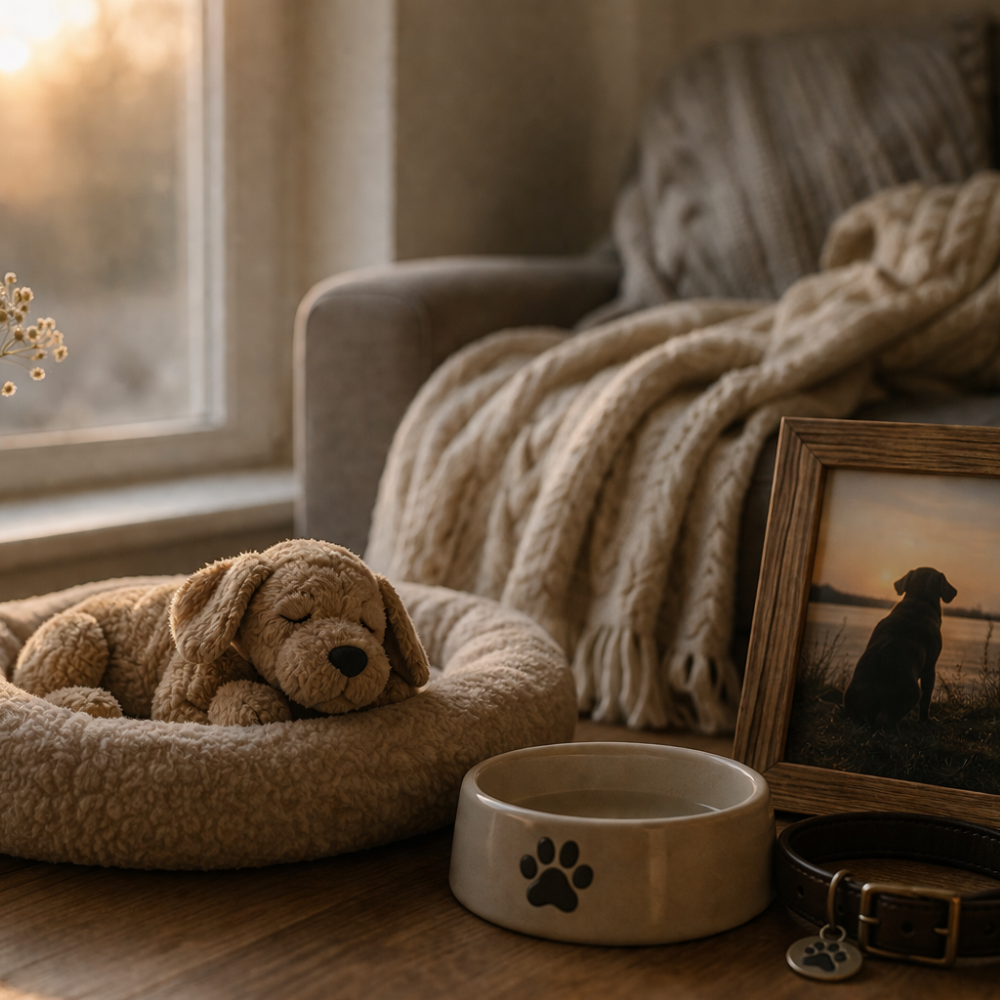
The hours and days that follow are unlike anything you were prepared for.
Nobody tells you what the first morning after losing a pet actually feels like. The way you wake up and for just a moment — before memory catches up — everything is still the same. And then it isn’t. And the day begins with that.
The first days of losing a pet are strange in ways that are hard to explain to someone who hasn’t been through it. The grief is real and present, but life continues around it — meals still need to happen, work still calls, other people still need things from you. And you move through all of it carrying something heavy that most people around you cannot see.
The shock that comes with losing a pet
Even when a pet’s death is expected — after a long illness, after a final decision made with a veterinarian — there is almost always a period of shock afterward. The mind knows what happened. The body takes longer to understand.
You may find yourself doing things out of habit. Reaching for the leash. Calling their name. Listening for sounds that will not come. This is not confusion. It is the nervous system catching up with a reality that the heart is not ready to accept.
These moments can feel disorienting. They are, in fact, entirely normal. The routines you built together over months or years don’t disappear overnight. They leave traces — and for a while, those traces feel almost like presence.
If you are finding the grief larger than you expected, this is what pet loss grief actually looks like — and why what you’re feeling is not too much.
What to do with their things after losing a pet
There is no right answer to this question, and anyone who gives you one is not telling you the truth.
Some people need to put things away immediately — the bowl, the bed, the toys — because having them in sight is too painful. Others cannot imagine moving anything, and leave everything exactly as it was for weeks. Both of these responses are valid. Both are grief.
What matters is not what you do with their things, but that you give yourself permission to do whatever actually helps. There is no correct timeline. There is no decluttering schedule that grief is required to follow.
If you’re not ready to move something, don’t. If you need to move everything today, move it. You are the only one who knows what you can bear right now.
Some people find comfort in choosing something that holds the memory in a different way — a small, lasting tribute rather than an empty space. You might find something like that here.
The people who don’t understand
In the first days, you will likely encounter people who say something unhelpful. Not out of cruelty — out of not knowing what to say, and reaching for something that sounds comforting.
“At least they had a good life.” “You can always get another one.” “I know it’s hard, but it was just a pet.”
These things land differently when you are in the middle of it. And it can be isolating — to be grieving something real while the people around you seem to think it should be smaller than it is.
You are not wrong for finding this hard. Losing a pet leaves a real absence — in the house, in the day, in the quiet moments that used to belong to them. The ASPCA’s pet loss support resources offer guidance for those who need more than their immediate circle can provide.
The physical weight of grief after losing a pet
Grief is not only emotional. In the first days after a loss, many people experience it physically — exhaustion that sleep doesn’t fix, a heaviness in the chest, difficulty concentrating, a strange flatness to ordinary things.
This is the body’s response to loss. It is real, and it is temporary, though it rarely feels temporary when you are in it.
Eating something. Drinking water. Moving through the air outside, even briefly. These things don’t fix grief. But they keep the body functioning while grief does what it needs to do.
What the first days of losing a pet are actually for
The first days are not for getting over it. They are not for moving on, or finding perspective, or feeling better.
They are for being in it. For letting the loss be as large as it is. For not pretending that you are fine when you are not.
Some people find it helps to talk — to tell stories about their pet, to say their name, to keep them present in conversation even though they are gone. Others need quiet. Others need to write things down before the details start to blur — not all at once, but gradually, the way small things do.
Whatever the first days look like for you — whatever you need to get through them — that is enough. You don’t have to do this correctly. You just have to do it.
Questions People Often Carry
What should I do in the first days after losing a pet?
There is no right way to move through the first days. Some people need to keep the routine; others need to change everything about it. What matters most is not managing the grief correctly — it is allowing it to exist without rushing it. Let the first days be what they are, without pressure to be okay yet.
Why does the house feel so wrong after losing a pet?
Because your home was shaped around their presence — the sounds, the rhythms, the particular way the day was organized around them. In the first days after losing a pet, the absence is loudest in the places that were most theirs. That is not imagination. That is the real weight of a real loss.
Is it normal to keep reaching for them out of habit after a pet dies?
Yes — and it can last longer than people expect. Habits built over years don’t stop because the loss is recent. Reaching for them, listening for them, expecting them in the places they always were — this is not a sign that something is wrong. It is a sign of how completely they were woven into your daily life.
How do I get through the first night after losing a pet?
There is no way to make the first night easy. What helps some people is keeping something of theirs close — a blanket, a collar, a familiar smell. Others find it easier to change the space slightly, so the absence is less loud. Do whatever makes the night survivable. There is no correct way to do this.
The first days don’t ask you to be brave. They only ask you to get through them.