
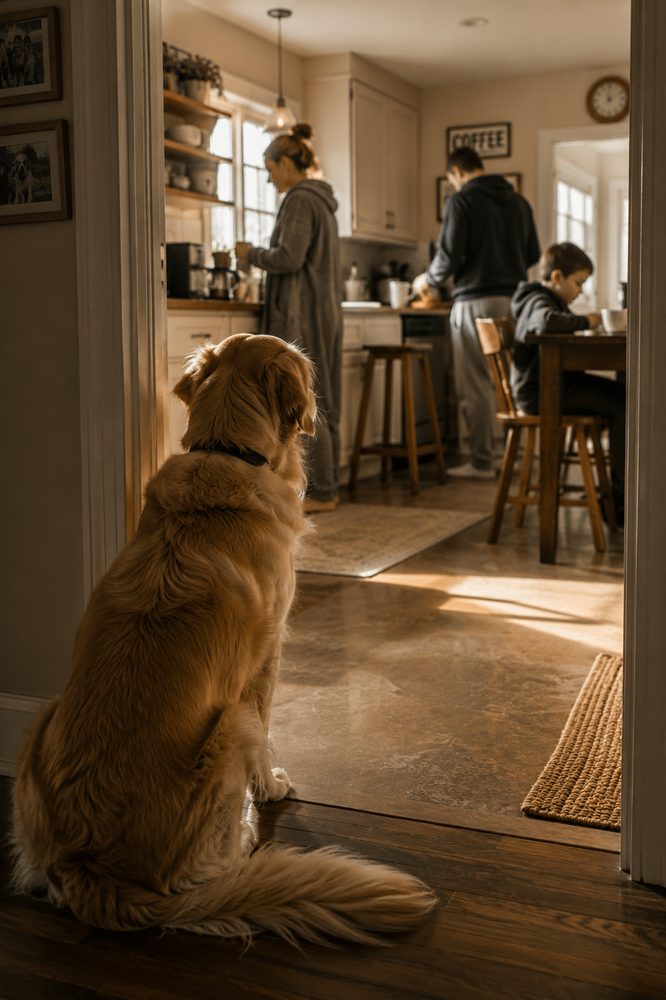
Your family’s smaller rituals are often so ordinary that nobody thinks to explain them. Someone gets up first. Someone else usually fills the food bowl. A particular sound from the kitchen means something interesting might be happening, while another barely earns a glance.
Nobody writes these patterns down. Nobody sits a pet down and teaches them. And yet, given enough time, your family’s smaller rituals can become familiar enough to be anticipated almost as reliably as anything deliberately taught.
This is the fifth and final thread pulled from a broader look at the things your pet knows before you say a word — the quiet familiarity pets build simply by living inside the same household rhythms, day after day.
Why Your Family’s Smaller Rituals Get Learned Without Teaching
Dogs are particularly skilled at using human social information. Research has shown that they can recognize familiar people and learn from repeated interactions with the humans around them. Studies of dog cognition have also shown how closely dogs attend to human social cues. The American Veterinary Medical Association explains how early and continued social experiences help dogs and cats learn how to respond appropriately to people, animals, places, and experiences around them.
The Different Roles People Come to Play
In a multi-person household, those associations can become surprisingly specific.
One person may usually initiate walks. Another is more often responsible for meals. Someone else may be the person who settles on the sofa at the end of the evening and, without ever inviting anyone, somehow ends up with a pet curled beside them.
These aren’t necessarily fixed roles, and pets don’t need to assign human-style labels to the people involved.
They simply experience different histories with different individuals.
One voice may predict play. A particular set of footsteps may mean someone has come home. Another person’s appearance in the kitchen may be far more interesting than everyone else’s.
Over time, your family’s smaller rituals give each person a slightly different place within the animal’s experience of the household.
Perhaps that is part of why pets can sometimes appear to have such specific expectations of different people.
They aren’t reading a family job description.
They’ve just been there for all the repetitions.
How Weekly Rhythms Become Familiar Too
Daily routines are the easiest patterns to see, but households repeat themselves over longer stretches as well.
Weekday mornings may begin early and quickly. Weekend mornings may stay quiet longer. One day of the week might regularly bring visitors, errands, cleaning, or a different pattern of people coming and going.
A pet doesn’t need to understand Monday or Saturday to notice those differences.
This connects with how living with a pet changes the way we notice time. Animals don’t need calendars to live inside recurring patterns. The sequence of familiar events can provide plenty of information on its own.
So when a dog seems to know that this morning is different, the calendar may have very little to do with it.
Everyone slept later.
Nobody put on work clothes.
Breakfast moved slowly.
The house itself feels like a weekend.
How Seasons Change Your Family’s Smaller Rituals
Then there are patterns that move even more slowly.
Summer evenings stay light longer, perhaps shifting the usual walk. Winter changes when the curtains close and how much time everyone spends indoors. School schedules change. Holidays bring different sounds, visitors, furniture, food, and activity.
Pets experience those changes alongside us.
That doesn’t mean they necessarily understand seasons as categories or maintain an internal annual calendar. But environmental changes and the routines associated with them can create recurring patterns.
After enough repetition, your family’s smaller rituals aren’t confined to one ordinary day. Some belong to mornings. Some belong to weekends. Others appear only when the light outside changes and the household gradually changes with it.
We tend to think we’re adjusting our lives to the season.
There may be someone else in the room adjusting too.
What Happens When a Familiar Ritual Changes
The importance of a routine sometimes becomes easiest to see when it disappears.
Someone starts a new job and leaves at a different hour. A child begins school. A family member who was usually home during the day isn’t there anymore. Walks move from morning to evening.
From the human perspective, these may be practical changes.
For a pet, they also change the collection of cues that used to predict how the day would unfold.
Some animals adapt without much visible difficulty. Others may become temporarily more watchful, follow people more often, check familiar places, or seem unsettled while a new pattern develops.
Changes in behavior aren’t automatically caused by routine disruption, though. If a pet develops persistent or concerning behavioral changes — particularly changes in appetite, elimination, sleep, activity, or signs of distress — a veterinarian can help rule out medical causes rather than assuming the new schedule is responsible.
Eventually, many ordinary household changes simply become the new ordinary.
The repetitions begin again.
The Rituals You Don’t Know You’re Performing
Perhaps the most interesting household patterns are the ones humans don’t recognize at all.
You may know that you feed the dog every morning.
You probably don’t know that you always open one cupboard first, place your mug in the same place, and reach for the food only after the kettle clicks off.
To you, those details are irrelevant.
To an animal trying to predict what happens next, they may not be.
This is the same kind of quiet learning behind a pet’s daily schedule. A routine doesn’t need to be intentionally designed before an animal can learn its shape.
We create patterns simply by living.
Pets get to watch them from the beginning.
What Your Family’s Smaller Rituals Reveal
There is something almost intimate about realizing how much ordinary information another animal has accumulated about your home.
They know which footsteps deserve attention.
They know when the kitchen becomes interesting.
They may recognize the beginning of bedtime long before anyone actually heads upstairs.
None of these things is spectacular.
That is precisely why they matter.
This final thread brings the larger series back to where it began. Knowing when you’re about to leave, anticipating a walk, reacting to a suitcase, noticing a change in mood, and learning the rhythm of an entire household can all emerge from the same simple condition:
Being there.
Watching.
Again and again, until what once looked random becomes familiar.
Eventually, the pet doesn’t merely live in the house.
In their own way, they know how the house goes.
Questions People Often Carry
Do pets really learn different routines with different family members?
They can learn associations involving individual people and repeated events. A dog may therefore behave differently around family members who regularly predict different activities, although that doesn’t necessarily mean the animal understands each person’s “role” in a human sense.
Why does my pet seem to know when it’s the weekend?
Your pet doesn’t need to understand the concept of a weekend. Later wake-up times, different clothing, altered meal timing, changes in household activity, and other recurring cues may make those days noticeably different.
Can a pet learn the routines of a new family member?
Yes. Repeated interactions give pets opportunities to learn the sounds, movements, habits, and activities associated with someone new. How quickly this happens varies with the individual animal and circumstances.
What happens when a long-standing household routine changes?
Pets can adapt to new routines, although some may show temporary behavioral changes while expectations adjust. Persistent or significant changes in behavior should not automatically be blamed on the schedule and are worth discussing with a veterinarian.
A house has a rhythm long before anyone thinks to name it — and somewhere in the room, someone’s already learned it by heart.