
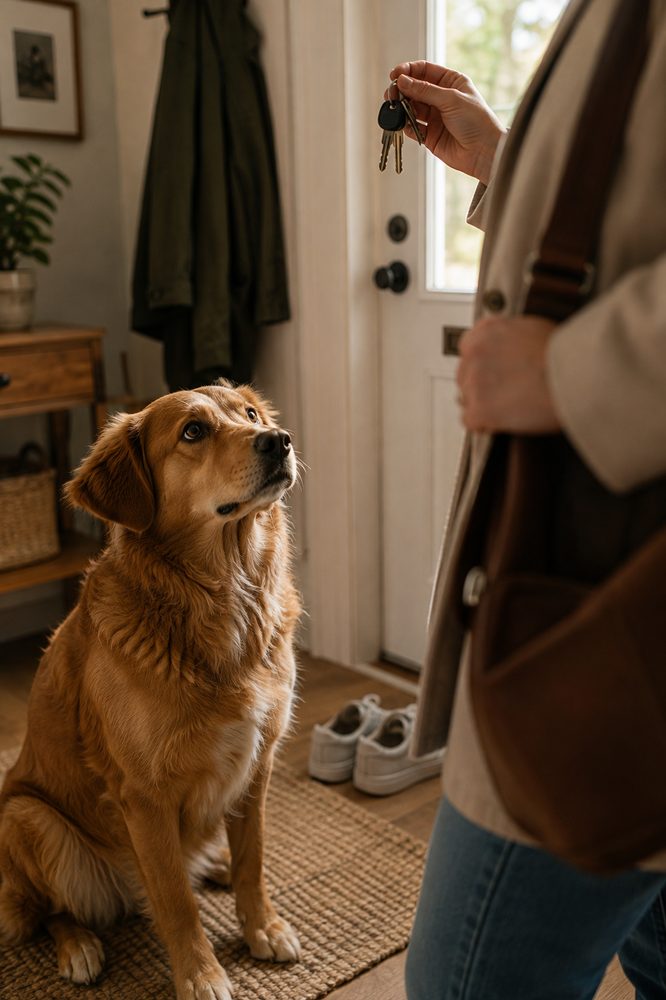
There is a particular moment familiar to almost anyone who lives with a dog. The keys leave the counter, and before a single word is spoken, the ears lift. The body straightens. Something in the room changes.
Somehow, a pet often seems to know when you’re about to leave before the actual departure begins. It might happen when the shoes go on or the jacket comes off its hook. Sometimes the reaction seems to start even earlier, which can make the whole thing feel almost uncanny.
It isn’t magic. It’s one of the clearest examples of how much information an animal can gather simply by living alongside the same person and watching the same routines unfold again and again.
It is also one small part of a much larger kind of familiarity — the way pets learn what you’re about to do before you say a word, simply by paying attention to the rhythms of an ordinary household.
How a Pet Learns When You’re About to Leave
A puppy or newly adopted dog doesn’t arrive already understanding that the sound of keys means someone is about to disappear through the front door. That association develops through repetition.
The same little sequence happens again and again.
Shoes. Coat. Bag. Keys. Door.
Eventually, individual pieces of that sequence can begin to predict what comes next.
The ASPCA describes these as predeparture cues, noting that some dogs may become anxious when their person puts on shoes or a coat, picks up a bag, or reaches for the car keys.
For a dog without separation-related distress, recognizing those signals may simply mean looking up from the sofa or following someone toward the door. For an anxious dog, the same cues can carry much more emotional weight.
Either way, the interesting part is how ordinary the signals are.
A pair of shoes means nothing on its own. After hundreds of repetitions inside one particular household, it can become information.
The Signals Begin Before the Keys Come Out
The obvious clues are only part of the story. Sometimes the household starts behaving differently before the familiar departure objects ever appear.
There may be more movement than usual. Clothes come out of cupboards. Someone makes extra trips between rooms or spends an evening distracted by preparations.
Veterinary behaviorist Leslie Sinn explains in a PetMD article about dogs noticing travel preparations that dogs can notice changes in routine and activity, including extra errands, clothes being pulled from drawers, and unusual movement around the home.
This helps explain why some dogs appear to know when you’re about to leave before the keys jingle or a suitcase reaches the hallway. There may not be one decisive clue at all. Instead, several small departures from the ordinary rhythm of the day begin adding up.
By the time you reach for the keys, your pet may already have been watching the story unfold for quite a while.
When Recognition Turns Into Anxiety
Recognizing a departure routine isn’t automatically a sign of separation anxiety. A dog who watches you put on your coat or follows you to the door may simply know what usually happens next.
The distinction matters.
Dogs experiencing separation-related distress may show more pronounced signs as their person prepares to leave, including pacing, panting, whining, drooling, trembling, or other anxious behavior. The ASPCA notes that some dogs with separation anxiety become distressed during the predeparture period itself.
So what looks like a pet “knowing” when you’re about to leave can describe very different experiences.
For one animal, it might mean a brief glance toward the door.
For another, those same familiar signals may have become associated with genuine distress.
That’s why it’s worth paying attention to changes rather than assuming every reaction is simply a quirky part of the routine. If a pet’s response becomes intense, persistent, or begins interfering with their wellbeing, a veterinarian or qualified behavior professional can help determine what is happening.
For milder moments of nervousness around changes in routine, some pet owners also explore environmental calming products as part of creating a quieter space. If that’s something you’re considering, you can read more about the Bodhi Dog Calming Spray and what it is designed for. A calming product shouldn’t be treated as a substitute for veterinary or behavioral help when a dog is showing significant separation-related distress.
Why Simply Picking Up the Keys May Not Fix It
One commonly suggested approach for predeparture anxiety is surprisingly simple: occasionally pick up the keys without leaving. Put on the coat and then sit down. Carry the bag into another room instead of heading through the door.
There is a sound idea behind this. If a cue stops reliably predicting an absence, its meaning can gradually change.
The ASPCA includes this kind of exercise in its guidance for dogs with predeparture anxiety. It recommends exposing a dog to familiar leaving cues in different orders without actually departing, while also emphasizing that changing a long-established association can require many repetitions over a period of weeks.
That last part matters.
If a dog has spent years learning that keys plus coat plus bag almost always means the same thing, a few evenings of casually moving the keys around the kitchen are unlikely to erase that history.
For dogs with more significant separation anxiety, the process becomes more complicated. Gradual desensitization needs to stay below the point at which the dog becomes distressed, and progressing too quickly can make the problem worse. In those cases, professional guidance is far more useful than trying increasingly elaborate tricks at home.
What Knowing When You’re About to Leave Reveals
There is something worth noticing beneath all this pattern recognition.
A pet who recognizes a departure routine has accumulated an extraordinary amount of information about an ordinary person’s life: which shoes usually mean what, when the keys matter, which movements are normal, and which small deviations deserve attention.
This same familiarity appears in the everyday sounds a pet learns to recognize around a home. The refrigerator door, a cupboard opening, familiar footsteps in the hallway — repeated often enough, ordinary sounds begin to carry meaning.
Knowing when you’re about to leave belongs to the same quiet system.
And perhaps the most interesting part is how easily it can go unnoticed from the other side. The animal learns the human routine in remarkable detail, while the human may take much longer to notice the animal’s response to it.
A dog stops resting and begins watching.
A cat disappears into another room when the suitcase opens.
Someone reaches for the keys, and a pair of eyes follows the movement immediately.
Noticing those reactions doesn’t mean we can know exactly what an animal is thinking. But it does close a little of the distance between being watched and watching back.
Questions People Often Carry
Is it normal for my dog to become anxious before I actually leave?
Some dogs with separation-related distress begin showing signs while their person is still preparing to go. Pacing, panting, whining, trembling, drooling, or attempts to prevent someone from leaving can all warrant attention, particularly when the behavior is intense or worsening.
Can training reduce a dog’s reaction to departure cues?
It can help in some cases. For predeparture anxiety, familiar cues can gradually be made less predictive by presenting them without always leaving. More significant separation anxiety generally requires a carefully paced desensitization plan, ideally with professional guidance.
Do cats also notice when someone is preparing to leave?
Cats can learn household routines and associations too, although their responses may look different from those of dogs. A change in behavior around departure doesn’t automatically indicate anxiety; the individual pattern and intensity matter.
Should I be concerned if my pet’s reaction to departures is getting worse?
A strong or worsening reaction is worth discussing with a veterinarian. Destructive behavior, escape attempts, persistent vocalization, house soiling, or other significant distress during separation can be associated with separation anxiety, and medical or other behavioral causes may also need to be considered.
Attention, given long enough, starts to look a lot like knowing.