
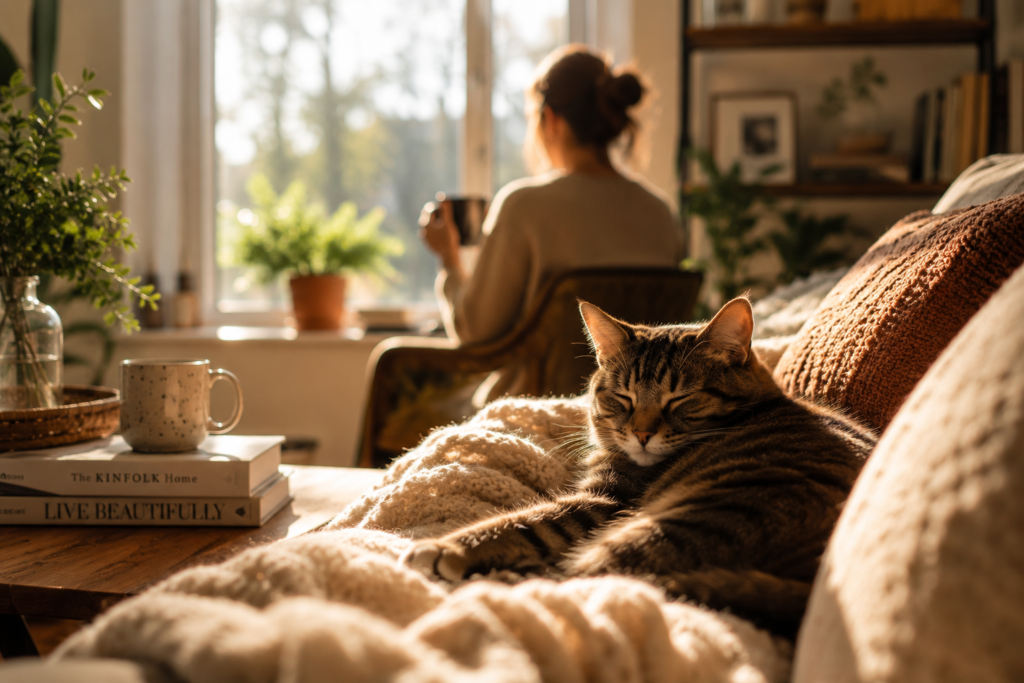
Nobody tells you, before you get a cat, how having a cat changes your day — not in a way you would have predicted, and not in the direction you might expect. A dog restructures a day around shared rhythm. A cat does something different. It restructures a day around its own rhythm — and then, quietly, invites you to notice it. Most people who live with cats describe the same experience: they didn’t change the cat’s routine. The cat changed theirs.
The Morning Is Theirs First
A cat does not wait for your morning to begin before beginning its own.
By the time you wake, something has already happened. The cat has moved through the house on its own schedule — investigated, settled, relocated. When you appear, you are not the start of the day. You are simply the next event in a day that was already underway.
This is not indifference. It is a particular kind of self-possession that most cat owners come to find quietly reassuring. The morning does not depend on you. It was already happening. You are welcome in it.
For many people, this reframes the first hour in an unexpected way. There is less pressure in a morning that doesn’t need you to begin it. You make coffee. The cat observes. The day starts at its own pace.
Their Presence Is on Their Own Terms
A cat will find you when it wants to be found.
Not when you call — usually. Not when it would be convenient. But at some point in the afternoon, or the early evening, or in the middle of something you were trying to concentrate on, a cat will appear and make itself available. It will settle nearby, or on you, and the quality of the room will change.
This is one of the things that is difficult to explain to people who haven’t lived with a cat. The presence is real — measurable, even. But it arrives on its own schedule. You cannot summon it. You can only be in the right place when it decides to happen.
Most cat owners stop trying to summon it fairly early. They learn instead to notice it when it arrives — and to stay a little longer than they planned.
The House Has a Different Quality of Quiet
A house with a cat in it is not a quiet house in the ordinary sense.
There is the sound of movement in another room — unhurried, purposeful, entirely independent. There is the particular silence of a cat watching something you cannot see. There is the weight of them settling somewhere nearby, and the specific quality of stillness that follows.
This is a different kind of company than a dog provides. It is less interactive, less directed at you. But it fills the space in its own way — gives the house a quality of being inhabited that is distinct from being alone, even when the cat is in another room entirely and has not acknowledged you in hours.
Research on the human-animal bond suggests that even passive animal presence — an animal simply existing nearby — has measurable calming effects. Cat owners tend to experience this not as a finding but as a fact of daily life. The house feels different when the cat is in it. Calmer. More complete.
They Set the Pace of the Evening
If a dog shapes the morning, a cat shapes the evening — and this is one of the quieter ways how having a cat changes your day.
There is a particular quality to a night when a cat has settled. The lamp is on. The cat has chosen its place — which may or may not be near you, depending on factors you will never fully understand. The evening has a texture it wouldn’t have without them.
Most cat owners find that they sit longer than they intended on these evenings. Not because they planned to. Because the cat is settled, and it would seem unnecessary to move, and the hour has a quality that makes staying feel like the obvious choice.
This is not a small thing. The capacity to simply be still — to let an evening be an evening rather than a list of things to finish — is something many people find genuinely difficult. A cat, without trying, makes it easier.
The Rules of Your Home Are Negotiated Differently
Living with a cat involves a particular kind of ongoing negotiation that living with other animals does not.
A cat will decide where it sleeps. It will decide which surfaces are available to it, regardless of your preferences on the matter. It will establish routines of its own — specific windows at specific times, specific spots for specific hours — and these routines will quietly become part of how the house runs.
Most cat owners describe this not as an imposition but as a reorientation. The house is no longer entirely yours. It belongs to both of you, according to an arrangement that was never formally discussed but is understood by both parties. There is something unexpectedly companionable about this. About sharing a space with a creature that has its own clear sense of how things should be.
How Having a Cat Changes Your Day — By the End
By the end, how having a cat changes your day is less about what happened and more about how the house felt throughout.
The day that ends with a cat is a different day than the one that began.
Not because of anything dramatic. Not because of the greeting, or the walk, or the shared activity. But because something has been present throughout — moving through the house on its own terms, settling in its own time, appearing when it chose to appear — and that presence has given the day a texture it wouldn’t otherwise have had.
Most people who live with cats describe a version of the same thing: the house feels more like a home. Not because the cat made it warmer, or louder, or more full of activity. But because something else is living in it. And that, it turns out, changes everything about how a space feels.
Questions People Often Ask About Living With a Cat
How does having a cat change your daily routine?
A cat changes a daily routine less visibly than a dog — there are no walks, no scheduled outdoor time — but the change is real. Feeding, play, and the particular rhythms of a cat’s day become woven into your own until the two are difficult to separate.
Are cats good for daily wellbeing?
Research on the human-animal bond consistently finds that cat ownership is associated with lower stress and a greater sense of calm. Cat owners often describe the effect not as something they pursue but as something that simply happens — the house is quieter, the evenings are slower, the day has a different quality.
What is it like to share a home with a cat?
Sharing a home with a cat involves a kind of ongoing, unspoken negotiation. The cat has its own routines, its own preferences, its own sense of how the space should be used. Most people find that accommodating this — living according to an arrangement that was never formally discussed — becomes one of the things they value most about life with a cat.
Do cats make you feel less alone?
Most cat owners would say yes — but not in the way a dog does. A cat’s companionship is quieter, less directed, more intermittent. It arrives on its own terms. But the sense of having another presence in the house, of not being entirely alone in a space, is real and consistent regardless of whether the cat is actively engaged with you.
A cat doesn’t fill your day the way other animals do. It moves through it on its own terms — and somehow, in doing so, gives your day a quality it wouldn’t otherwise have.
If you’re noticing the particular rhythms and quiet moments that make life with a cat feel like your own, the Paws and Memories journal was made for holding those details before they become something you only half-remember.


