
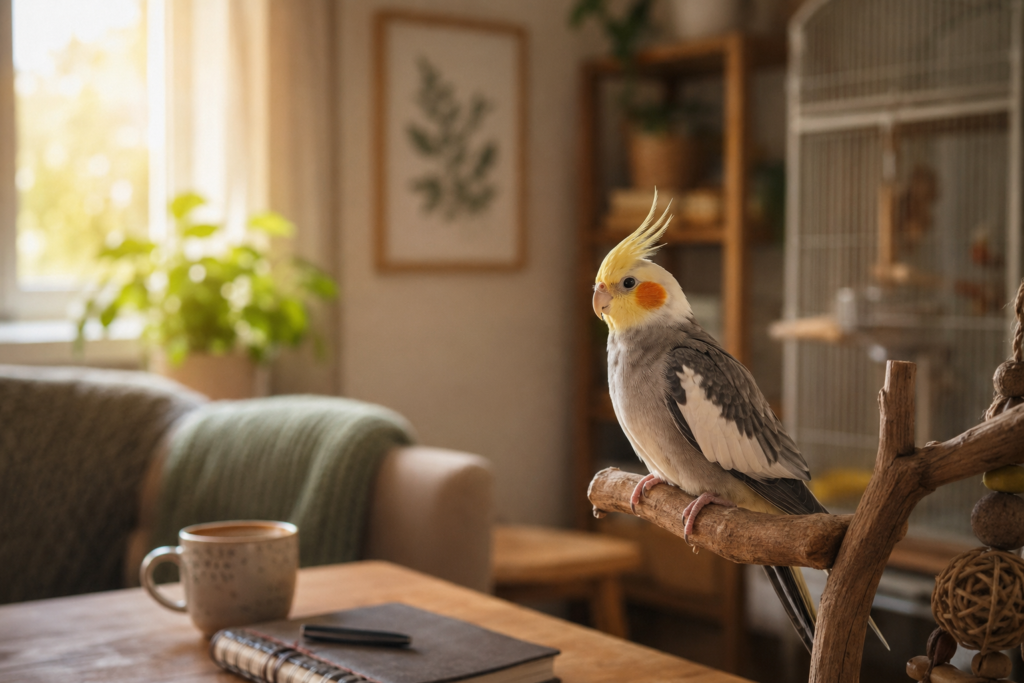
Not quietly. Not without announcement. A bird makes itself known — and that changes everything.
Nobody tells you, before you get a bird, how having a bird changes your day — not in the particular way it does, and not in the direction you might expect.
A dog restructures a day around movement. A cat reshapes it around stillness. A bird does something different entirely. A bird fills a day with sound, with presence, with a quality of attentiveness that runs in both directions — and once you’ve known that, a quiet house feels like something is genuinely missing..
The Morning Begins With a Voice
A bird does not wait to be noticed.
By the time you wake, something is already happening. There is sound in the house — not noise, not disturbance, but the particular vocal presence of an animal that knows you are there and has something to say about it. The morning, for a bird owner, begins differently than it does for anyone else.
This is one of the first things most bird owners describe when they talk about life with a bird: the sound. Not as an inconvenience — as a presence. The house is no longer silent in the morning, and that absence of silence turns out to feel, surprisingly quickly, like company.
They Know When You’re There
A bird pays attention to you in a way that is easy to underestimate until you’ve experienced it.
They notice when you enter a room. They respond to your voice, your movements, your mood. They have a particular sound for when you arrive and a different one for when you’ve been away too long. This attentiveness — this quality of being genuinely noticed by another creature — changes the texture of a day in ways that are difficult to articulate but immediately felt.
Most bird owners describe a version of the same experience: they didn’t expect to feel so seen. A bird’s companionship is not passive. It is active, expressive, and directed specifically at you — and that directedness gives a day a quality of mutual presence that other small pets rarely replicate.
If you’re looking for a home that gives your bird the space to express that presence fully, the VISCOO Bird Cage provides the room and the perches for a bird to move, settle, and engage on its own terms.
The Afternoon Has a Different Sound
A house with a bird in it is not the same house as one without.
There is sound in the background of the afternoon — intermittent, varied, entirely alive. The particular call that means contentment. The sound they make when they’re investigating something new. The quiet that falls when they settle, and the way that quiet feels different from the quiet of an empty room.
Research on the human-animal bond suggests that even passive animal presence has measurable calming effects. For bird owners, that presence is rarely passive — it is vocal, visible, and consistently engaged with the world around it. The afternoon has a texture because of that engagement. A quality of being inhabited that changes how the hours feel.
The Way You Come Home Is Different
Coming home to a bird is not the same as coming home to silence.
There is a greeting — not the exuberant greeting of a dog, but something more specific and, in its own way, more personal. A sound that means: I noticed you were gone, and I notice you’re back. Most bird owners describe this as one of the most unexpectedly meaningful parts of their day. The transition from outside to home is marked by something that registers immediately, before you’ve set anything down.
The Evening Settles Into Something Quieter
As the light changes, a bird settles.
The vocal presence of the day softens in the evening. There is still sound — but quieter, more intermittent, more like the comfortable murmur of a household winding down than the active engagement of the day. The bird finds its perch. The house finds its rhythm. The evening has a particular quality when another creature is settling into it alongside you.
Most bird owners find that this transition — from the active presence of the day to the quieter companionship of the evening — is one of the things they notice most about life with a bird. The day has a shape it didn’t have before. A beginning, a middle, and an end that all feel inhabited.
The Decisions of a Day Begin to Include Them
Somewhere in the middle of life with a bird, something shifts.
How long will you be out? Is the cage positioned somewhere with enough light? Is there something new for them to investigate today? These questions become part of how a day is organized — not as a burden, but as the natural result of sharing a life with something that notices your presence and responds to your care.
Most bird owners describe this shift as one they wouldn’t undo. The day that includes a bird is more structured, more present, more like something that belongs to both of you.
By the End, the House Feels Inhabited
The day that ends with a bird in the house shows exactly how having a bird changes your day — not through drama, but through presence.
Not because of anything dramatic. But because something has been present throughout — vocal, attentive, alive in a way that fills the house with a quality it wouldn’t otherwise have. Most people who live with birds describe the same thing: the house feels more inhabited. Not louder, necessarily. Just more alive.
That aliveness is what a bird gives a day. Consistently, expressively, and entirely on its own terms.
Not because of anything dramatic. But because something has been present throughout — vocal, attentive, alive in a way that fills the house with a quality it wouldn’t otherwise have. Most people who live with birds describe the same thing: the house feels more inhabited. Not louder, necessarily. Just more alive.
That aliveness is what a bird gives a day. Consistently, expressively, and entirely on its own terms.
Questions People Often Ask About Living With a Bird
How does having a bird change your daily routine?
A bird changes a daily routine through sound and social engagement more than through physical care demands. Feeding, cleaning, and daily interaction become woven into the rhythm of a day — and the bird’s vocal presence fills the hours in between in ways most owners describe as genuinely companionable.
Are birds good companions for daily life?
Most bird owners are surprised by how socially engaged birds are. They notice your presence, respond to your voice, and develop specific vocalizations for different moments of the day. Their companionship is active and expressive — different from a cat or dog, but deeply rewarding in its own way.
Do birds make a house feel less empty?
Consistently, yes. The vocal presence of a bird fills a home with sound and life in a way that passive pets don’t. Most bird owners describe their home as feeling genuinely different — more inhabited, more alive — after a bird arrives.
What do you need to know before getting a bird?
Birds are social animals that need daily interaction and mental stimulation. They can live for many years — some species for decades — making them a long-term commitment. The quality of their environment matters significantly: a spacious cage with perches, enrichment, and good positioning makes a real difference to their wellbeing and their engagement with daily life.
A bird fills a home with something you didn’t know was missing — a voice, a presence, a small and living reminder that the day is worth paying attention to.
If you’re noticing the sounds, rhythms, and small moments of attention that make life with a bird feel uniquely yours, the Paws and Memories journal was made for holding those details before they become something you only half-remember.