
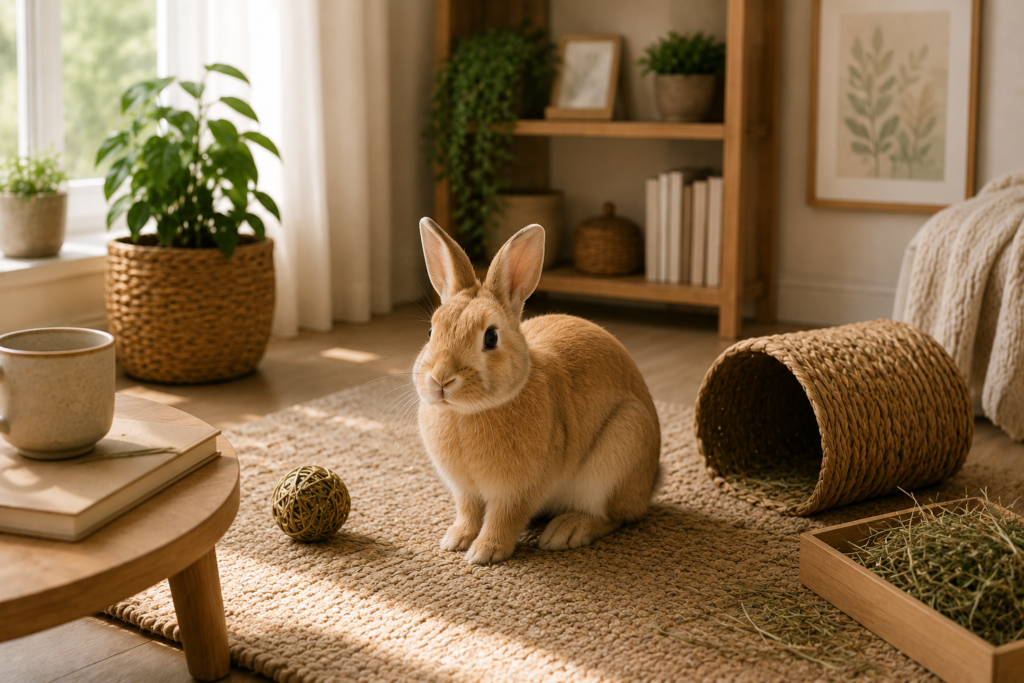
Quiet. Self-contained. And more present than you expected.
Nobody tells you, before you get a rabbit, how having a rabbit changes your day — not in the way a dog changes it, and not in the way a cat does either. A rabbit is its own kind of presence. Quieter than most people expect. More observant. More deliberate in the way it moves through a space — and the change it brings to a day is subtle, but real.
The Morning Has a Different Kind of Stillness
A rabbit is a crepuscular animal, most active at dawn and dusk—the edges of the day that many people move through without much attention.
Living with a rabbit changes those hours. The early morning, when your rabbit is naturally alert and curious, becomes a different kind of beginning. There is movement before you’ve fully woken up. There is the quiet sound of a small animal exploring its space—unhurried, purposeful, entirely itself.
Most rabbit owners describe the morning as the time they feel most accompanied. Not because a rabbit demands attention, but because sharing an early hour with another living creature changes the atmosphere of the room in a way that’s difficult to explain until you’ve experienced it.
The Way They Use Space Changes How You Use It
A rabbit that has room to move changes the way a home feels.
They explore with quiet confidence—investigating corners, returning to favorite places, choosing where to rest with a consistency that gradually becomes comforting. You learn which patch of floor they prefer in the afternoon. You notice where they settle when they want to be close without being held.
One of the biggest surprises for new rabbit owners is how much personality rabbits express simply through the way they move around their environment. They are curious animals with clear preferences, familiar routines, and surprisingly individual habits.
A good enclosure gives them the freedom to express those natural behaviors. If you’re looking for one that works well for indoor use, we recommend the VISCOO Small Animal Playpen — spacious, modular, and easy to set up at home.
The Afternoon Belongs to Both of You
Rabbits are social animals, and they notice when you are there.
Not in the way a dog notices—with enthusiastic greetings or constant attention—but in quieter ways that become easy to recognize over time. The way they move a little closer when you sit on the floor. The relaxed posture that tells you they feel safe. The moment they decide, entirely on their own, to settle within reach.
Most rabbit owners describe a version of the same experience: they didn’t expect to feel so noticed. A rabbit doesn’t perform affection. It simply offers it in its own time and on its own terms, and that quiet trust grows into something remarkably meaningful.
The Evening Settles Differently
As daylight begins to fade, your rabbit becomes active again.
This second crepuscular period overlaps naturally with the time many people are winding down after work. There is something quietly companionable about that rhythm. The rabbit explores its space while the house becomes calmer. The day slows for both of you, just in different ways.
Many rabbit owners say this is when they become most aware of their rabbit’s presence—not because it asks for attention, but because it fills the room with a gentle sense of life that makes the evening feel less empty.
The Decisions of a Day Begin to Include Them
Somewhere along the way, how having a rabbit changes your day becomes less about routine and more about perspective.
Research on the human-animal bond consistently finds that caring for another living creature — even a quiet, small one — has measurable effects on daily wellbeing and sense of purpose. Most rabbit owners experience this not as a finding but as a feeling: the day simply has more shape because of them.
How long will you be out? Is there fresh hay? Fresh water? Is the play area ready? Is there something new to investigate today?
These questions quietly become part of everyday life—not because they feel like chores, but because caring for another living creature naturally becomes part of how you organize your day.
Many rabbit owners discover that this gentle structure is something they come to value. It encourages presence, consistency, and the quiet satisfaction of caring well for something that depends on you.
By the End, the Day Has a Different Quality
In the end, how having a rabbit changes your day isn’t really about routines at all.
It’s about the quiet feeling that your day is shared with another living creature.
Not because of anything dramatic. Not because of walks, commands, or constant interaction. But because something small and alive has been present throughout the day—moving through its favorite spaces, quietly observing, settling nearby whenever it chooses.
That presence gives an ordinary day a texture it wouldn’t otherwise have.
Quietly.
Consistently.
Without asking for very much in return.
Questions People Often Ask About Living With a Rabbit
How does having a rabbit change your daily routine?
A rabbit changes your routine more quietly than a dog or cat. Feeding, cleaning, refreshing hay and water, and spending time together gradually become part of the natural rhythm of your day.
Are rabbits good companions for daily life?
Most rabbit owners are surprised by how companionable rabbits become. They notice your presence, develop routines around you, and build trust over time. Their companionship is quiet, but deeply rewarding.
Do rabbits need a lot of space?
Yes. Rabbits are active animals that benefit from having enough room to hop, explore, stretch, and express natural behaviors. A spacious enclosure or indoor playpen contributes significantly to both their wellbeing and their confidence.
What do you need to know before getting a rabbit?
Rabbits can live 8–12 years with proper care, making them a long-term commitment. They are intelligent, social, and curious animals that thrive with space, enrichment, and consistent daily care. They aren’t low-maintenance pets—but many owners find the quiet companionship they offer to be well worth the commitment.
A rabbit doesn’t ask for much. It asks only to be given space, time, and the particular kind of attention that comes from learning to read something quiet.
If you’re noticing the small routines and unhurried moments that make life with your rabbit feel uniquely your own, the Paws and Memories Journal was created to help you preserve those everyday memories before they quietly become the ones you miss most.


