
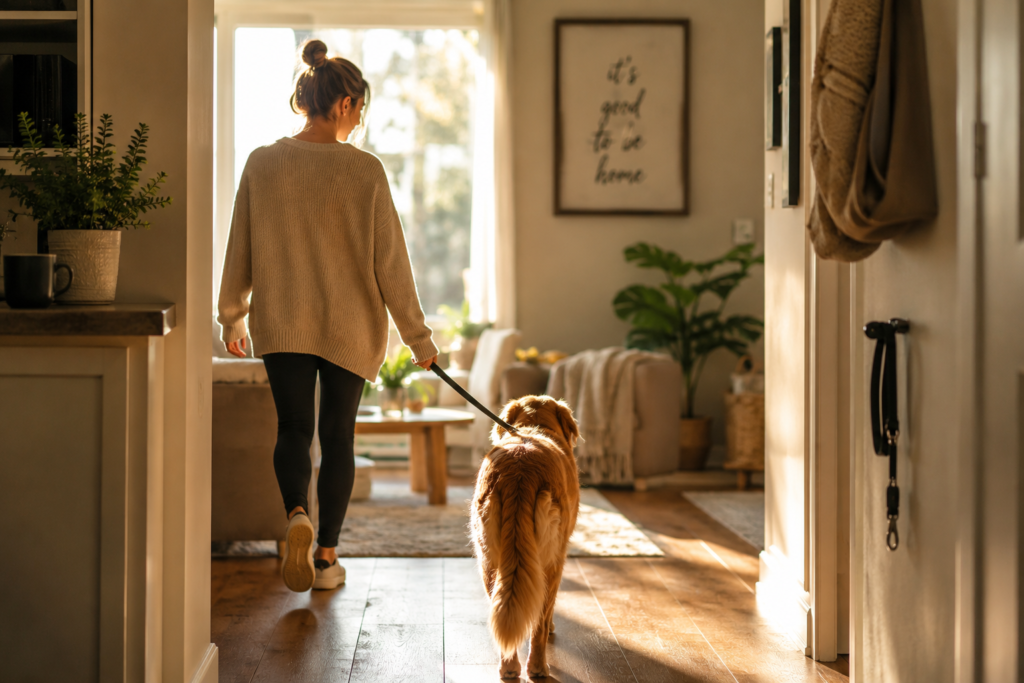
Nobody tells you, before you get a pet, how having a pet changes your day — not in a way that announces itself, not all at once. But gradually, over the first weeks and months, the structure of a day begins to shift. The morning has a different beginning. The evening has a different rhythm. The way you move through your own home starts to include something it didn’t include before.
It happens so quietly that most people don’t notice it while it’s happening. They notice it later — when the routine is already so familiar that the life before it is genuinely difficult to remember.
The Morning Belongs to Both of You Now
Before a pet, mornings were entirely yours. They expanded or contracted depending on how you felt. Some days you moved slowly. Others you skipped things entirely, letting the morning dissolve into the day without much ceremony.
A pet changes that. Not by making mornings harder — but by giving them a shape they didn’t have before.
There is feeding. There is, for dog owners, the walk that gets you outside before the rest of the world has fully started. There is the particular quality of a morning when something is already awake and glad that you are too. That quality changes the texture of the first hour — makes it more present, more grounded, more like a beginning rather than just an interval between sleep and obligation.
Most people don’t expect the morning walk to become one of the most meaningful parts of their day. And then it does.
The Way You Come Home Is Different Now
Coming home to a pet is not the same as coming home to an empty space.
It isn’t about the greeting — though the greeting is real. It’s about the particular quality of arrival that comes from knowing something is waiting. Not performing for you. Not filling the space with noise. Just being present in a way that registers before you’ve even set your bag down.
This changes over time into something that is difficult to name. The transition from the outside world to home becomes a different kind of transition. There is a moment — brief, unremarkable, entirely ordinary — when the outside releases its hold and something quieter takes over. Most people with pets can identify that moment without being able to fully explain it.
Your Sense of Time Starts to Include Theirs
One of the subtler changes that comes with having a pet is what happens to your internal clock.
You start to know what time it is by their behavior. The particular restlessness that means it’s almost feeding time. The way they settle in the evening when the day is winding down. The specific hour when they always come to find you, wherever you are in the house, and simply be nearby.
This is not inconvenient. It is, for most people, one of the unexpected pleasures of life with a pet — the way another creature’s rhythms begin to interweave with your own until you can no longer fully separate them. Their day becomes part of how you experience your day. Their sense of time becomes, in a quiet way, your sense of time.
The Pace of a Day Slows Down
There is something about having a pet that makes certain things slower.
The walk that could be hurried — but isn’t, because they want to investigate something, and you find you don’t actually mind. The evening when you sit longer than you intended because they have settled against you and it would seem unnecessary to move. The particular quality of a Sunday afternoon when a pet is sleeping in a patch of sunlight and the whole room seems to hold still around them.
Research on the human-animal bond suggests that this slowing down is not accidental. The presence of an animal regulates the nervous system in measurable ways — lowering cortisol, encouraging the kind of relaxed attentiveness that modern life tends to crowd out. Most pet owners experience this not as a finding but as a feeling: the day is a little slower, a little more bearable, a little more like something that belongs to them.
The Decisions You Make Start to Include Them
Somewhere in the middle of life with a pet, something shifts.
Your decisions begin to involve them automatically. Not as an afterthought — as a natural part of how you think. How long will you be out? Is there somewhere they can go? What will the week look like for both of you?
This is not a burden. It is a reorientation — the particular shift that happens when a life expands to include another creature’s needs as naturally as it includes your own. Most people who have lived with a pet for any length of time describe this shift as one they wouldn’t undo. The day that includes them is simply a better-organized day. A day with more structure, more reason to be present, more of the kind of small accountability that turns out to feel like purpose.
How a Pet Changes Your Day — From Morning to Evening
The day that ends with a pet is not the same as the day that began.
There is the particular quality of an evening when another creature is settled and content nearby. The specific sound of them breathing when the house is otherwise quiet. The way the last hour of the day becomes its own kind of punctuation — unhurried, domestic, entirely ordinary.
Most people, looking back at the version of their days before they had a pet, describe a kind of openness in the schedule that felt normal then and unfamiliar now. Not because life was worse, but because it had a different rhythm. A different texture.
That texture is what a pet gives a day. Quietly, consistently, and entirely without asking anything in return except to be included.
Questions People Often Ask About How Pets Change Daily Life
How does having a pet change your daily routine?
Having a pet restructures a day around another creature’s needs — feeding times, walks, companionship — in ways that most people initially think of as obligation and later describe as the best part of their routine. The structure a pet introduces tends to make days feel more purposeful and more present.
Do pets make you slow down?
Many pet owners describe a noticeable change in pace after getting a pet — longer walks, longer evenings, more time spent simply being still. Research supports this: the presence of an animal has measurable calming effects on the nervous system, and the daily routines of pet care tend to encourage a more grounded relationship with time.
Why does coming home feel different when you have a pet?
Coming home to a pet changes the quality of arrival. The transition from outside to home becomes more distinct — marked by a presence that registers immediately, even before any interaction. Most people describe this as one of the most significant changes to their daily experience of home.
How does life change after getting a pet?
Life with a pet changes gradually rather than all at once — the morning gains a shape, the evening gains a rhythm, and decisions start to naturally include another creature’s needs. Most people find that these changes, taken together, make daily life feel more structured, more present, and more like something that belongs to them.
A pet doesn’t just join your life. It gives your day a shape it didn’t have before — and a quality of presence that, once you’ve known it, is genuinely difficult to imagine living without.
If you’re noticing the routines, rhythms, and small moments that make life with a pet feel uniquely yours, the Paws and Memories journal was made for capturing those details while they’re still part of everyday life.


