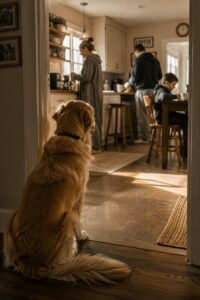
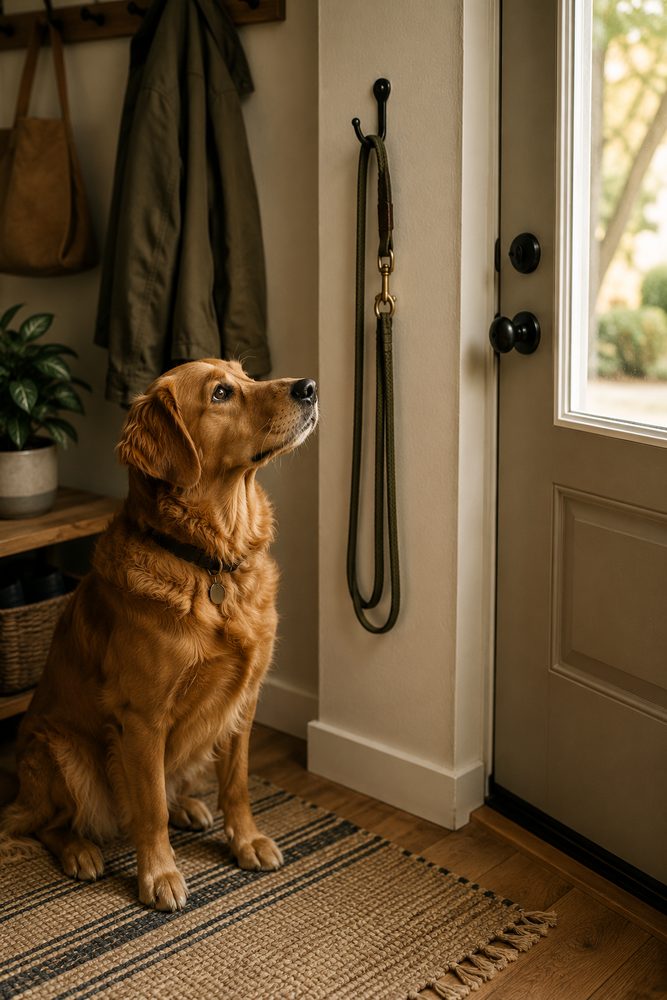
There is a particular restlessness that appears in the minutes before a walk. A dog who seemed perfectly settled begins watching the room more closely. There may be a trip toward the door, a glance at the leash, or the unmistakable sense that waiting has suddenly become difficult.
Somehow, a walk is coming, and the dog already seems to know it. No clock has been checked. No words have been spoken. Sometimes nobody has even reached for the leash yet.
It can look almost like an internal alarm going off at exactly the right moment. The reality is probably less mysterious, but in its own way even more interesting: dogs have spent an extraordinary amount of time learning the rhythms, signals, and repetitions of the households they live in.
This is the second thread pulled from a broader look at the things your pet knows before you say a word — the quiet familiarity pets build simply by paying attention to what tends to happen next.
How a Dog Knows a Walk Is Coming Without Being Told
Dogs don’t need to understand clock time the way humans do to anticipate recurring parts of their day.
Like other animals, dogs have circadian rhythms — biological processes that follow an approximately 24-hour cycle and are influenced by environmental signals such as light and darkness. These rhythms help organize recurring patterns of sleep and activity. The Merck Veterinary Manual also describes how animal behavior is shaped by learning and environmental cues, helping explain why repeated household routines can become meaningful predictors of what happens next.
Put the two together, and an apparently uncanny sense of timing becomes easier to understand.
If a walk usually happens during the same part of the morning, the dog has more information available than the number displayed on a clock. Morning light has a familiar quality. The household begins moving. Breakfast may already have happened. Certain doors open, particular sounds occur, and the people in the house begin behaving in ways that have preceded hundreds of previous walks.
Eventually, a walk is coming can become a prediction assembled from many small clues rather than one obvious signal.
Why Even a Day Off May Not Change the Timing
Anyone who has hoped a dog might understand the concept of sleeping late on Saturday has probably discovered the weakness in that plan.
When a routine repeats often enough, changing your own schedule doesn’t necessarily change the expectations that have grown around it. A dog accustomed to activity at roughly the same time each morning may become alert around that time even when everyone else intends to stay in bed.
Environmental cues can reinforce those expectations. Light changes throughout the day, household activity develops its own rhythm, and familiar events tend to happen in a recognizable order.
That means a dog doesn’t necessarily need one dramatic signal to realize a walk is coming. The prediction may emerge from several things happening together: the time of day, the light outside, breakfast being finished, familiar movements around the house, and the subtle beginning of the routine that usually ends at the front door.
From the human side, it looks as though the dog knows the time.
From the dog’s side, the whole house may be telling the time.
What Happens When the Routine Changes
The same expectations become particularly noticeable when the usual routine doesn’t happen.
A dog may begin checking the door, following someone through the house, or becoming more restless around the time a walk normally occurs. That doesn’t necessarily mean the dog is distressed, and it certainly doesn’t mean every dog will react in the same way.
It may simply mean that something expected hasn’t happened yet.
Dogs can learn multiple recurring patterns across a day. Meals, walks, play, someone’s return from work, and the household settling down for the evening can all become parts of a familiar sequence.
This is one reason a pet’s daily schedule can begin to feel surprisingly precise even when nobody deliberately created one. The schedule grows from repetition until both sides of the relationship seem to be living inside it.
And then one afternoon you are ten minutes late getting up from the sofa, and someone is standing by the door looking deeply concerned about your time-management skills.
The Anticipation Before a Walk Begins
There is something else happening in those minutes before the door opens: anticipation itself.
The walk hasn’t started, but the experience already has.
The dog becomes more alert. The leash suddenly matters. A person moving toward the hallway becomes worth following. In an excited dog, the whole body may seem to join the prediction.
Learning research supports the broader idea that cues associated with rewarding outcomes can themselves acquire significance. In other words, an animal doesn’t have to wait for the rewarding event before responding; signals that reliably predict it can begin to produce anticipation of their own.
That’s why the moments before a walk is coming can become part of the ritual rather than simply empty waiting.
Something similar happens with the unspoken rules that build around car rides. The trip begins emotionally before the car moves. A familiar sequence starts, the animal recognizes it, and anticipation becomes part of the experience.
The Clues You Probably Don’t Realize You’re Giving
The leash is obvious.
You may be less obvious to yourself.
Perhaps you put your phone in a pocket before every walk. Maybe you finish your coffee, push the chair back in a particular way, or glance outside before standing up. You might use a different pair of shoes or change the tone of your voice without realizing it.
None of those things has to mean anything the first time.
After enough repetitions, they can.
This is part of what makes living with an animal so interesting. We tend to notice the signals we’ve deliberately created — the word walk, the leash, perhaps a command to wait by the door — while overlooking the dozens of signals we never intended to teach.
A dog gets to see all of them.
And because the dog isn’t separating the important parts of the routine from the irrelevant ones in quite the way a person might, a tiny gesture can become unexpectedly informative simply because it has reliably appeared before the same outcome.
What Knowing a Walk Is Coming Reveals
A dog who reliably anticipates a walk isn’t necessarily responding to one internal clock or one perfectly learned cue. More likely, several kinds of information are working together: biological rhythms, environmental changes, learned associations, and the endlessly repeated behavior of the humans nearby.
That makes the result less magical, but not less remarkable.
A dog has effectively become fluent in one very specific household.
The same familiarity appears in the everyday sounds a pet learns to recognize. A cupboard door, footsteps in the hallway, the refrigerator opening, or a familiar car outside can gradually acquire meanings that nobody deliberately assigned to them.
Walk anticipation belongs to that same quiet language.
You may think nothing has happened yet.
Your dog may have been watching the beginning happen for the last ten minutes.
Questions People Often Carry
Does my dog actually understand clock time, or just routine?
Dogs aren’t thought to understand abstract clock time in the human sense. Their anticipation can instead draw on biological rhythms, environmental cues, learned associations, and the repeated order of events throughout the day.
Why does my dog still wake up for a walk when I want to sleep later?
A well-established routine doesn’t automatically disappear because your plans changed for the day. Familiar light, activity, biological rhythms, and other recurring signals may still be present even when you intend to sleep in.
Is it bad if my dog’s walk happens at different times?
Not necessarily. Dogs can adapt to variation, and there isn’t one exact schedule that suits every dog or household. If changing routines cause marked anxiety or other significant behavioral changes, however, it is worth discussing them with a veterinarian or qualified behavior professional.
Why does my dog know it’s nearly walk time before I touch the leash?
The leash may simply be one of the final cues. Your dog may already have noticed the time of day, changes in light, household sounds, your movements, or several other small signals that have repeatedly appeared before previous walks.
Some clocks are made of gears. Others are made of nothing but repetition and love.