
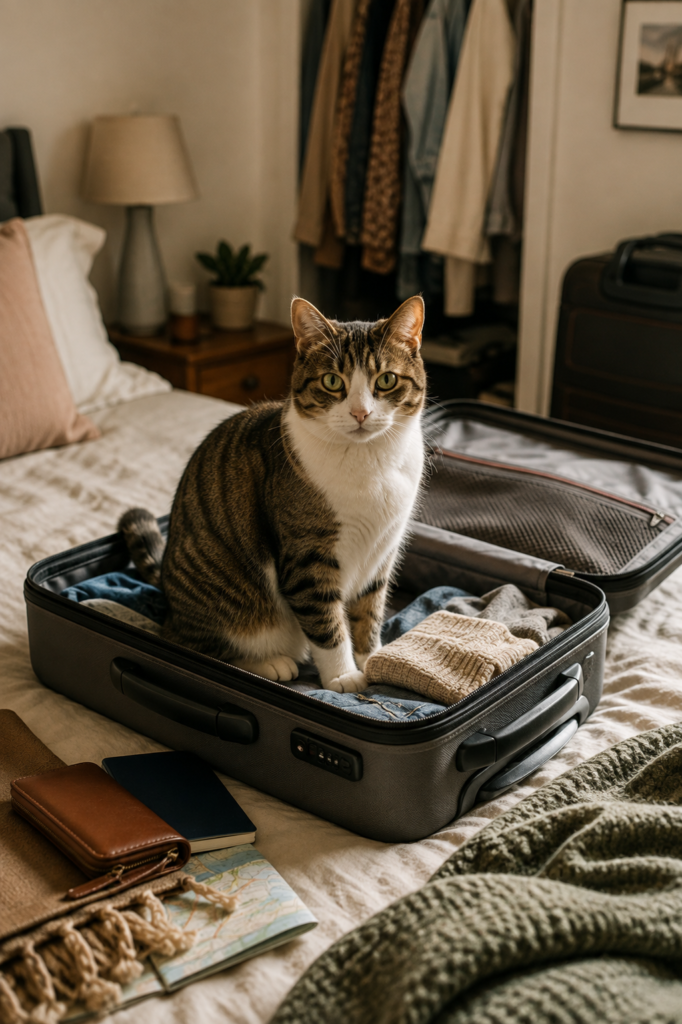
A gym bag gets pulled out of the closet without a second glance. A grocery tote comes and goes so often that it barely seems worth noticing. But a suitcase can change the atmosphere of a room almost as soon as it appears.
For many pets, the suitcase means something distinctly different from an ordinary bag. Its shape, the sound of the zipper, the clothes appearing on the bed, and the unusual movement around the house can all belong to a familiar pattern.
The suitcase itself doesn’t need to have any meaning at first. Meaning arrives through everything that has happened around it before.
This is the third thread pulled from a broader look at the things your pet knows before you say a word — the quiet familiarity pets build simply by watching a household closely enough, for long enough.
Why the Suitcase Means Something Different
Dogs and cats can learn associations between ordinary cues and what tends to follow them. A suitcase is particularly interesting because, in many households, it appears relatively rarely and often alongside a larger disruption of the normal routine.
Packing changes things.
Drawers open that usually stay closed. Clothes move from wardrobes to beds. Toiletries appear in unusual places. Someone walks repeatedly between rooms, making lists, finding chargers, folding things, and generally behaving just differently enough to be worth watching.
The suitcase is only one part of that larger collection of signals.
Veterinary behaviorist Leslie Sinn explains in a PetMD discussion of how dogs respond to travel preparations that dogs can notice changes such as unusual activity, extra errands, and clothes being taken from drawers. These changes can become signals that the household’s familiar routine is shifting.
By the time the suitcase reaches the bed, your pet may already have noticed that something unusual is happening.
When the Suitcase Means Excitement Instead
Not every animal sees a suitcase and expects something unpleasant.
For a dog who regularly travels with the family, packing might have been followed by car rides, new places, long walks, or simply more time together. In that household, the appearance of luggage may become associated with something interesting rather than an absence.
Another pet may have a very different history.
If suitcases have repeatedly appeared before the household empties, a sitter arrives, or the pet stays somewhere unfamiliar, packing may become associated with disruption instead.
That doesn’t mean a pet is consciously remembering previous holidays in the way a person might. A simpler explanation is enough: familiar cues have repeatedly predicted particular outcomes.
So the suitcase means whatever experience has gradually gathered around it.
The same object can therefore produce very different reactions in different homes — curiosity in one animal, excitement in another, and uneasiness in a third.
The Suitcase Is Probably Not the First Clue
It is easy to give the suitcase all the credit because it is the most visible part of packing.
But consider everything that happened before it appeared.
Perhaps laundry was done on an unusual day. Clothes were laid across the bed instead of being put away. A cupboard that rarely opens was searched for travel adapters. The normal evening disappeared beneath a series of small preparations.
Individually, none of these details announces a trip.
Together, they make the household different.
This mirrors what happens with the signals pets notice when you’re about to leave. Keys and shoes may be the obvious cues, but an animal has access to the entire sequence leading up to them.
The suitcase may simply be the moment when humans finally notice that the pet has been noticing too.
When Recognition Becomes Anxiety
A pet paying attention to packing isn’t automatically anxious.
A cat climbing into an open suitcase may simply have discovered an interesting new place to sit. A dog following someone from room to room might be curious about unusual household activity. Behavior needs context before we can confidently decide what it means.
There are, however, pets for whom departure-related cues are connected with genuine distress.
The ASPCA notes in its guidance on separation anxiety that dogs with separation anxiety may begin showing signs while their person is still preparing to leave, reacting to familiar predeparture cues such as putting on shoes, picking up keys, or getting ready to go.
That distinction matters here too.
If a pet simply watches the suitcase appear, that is one thing. If packing consistently brings intense pacing, panting, vocalization, escape attempts, destructive behavior, refusal to eat, or other marked changes, the concern is no longer really about luggage.
The suitcase may simply be the earliest visible part of a larger separation-related problem.
Can You Change What the Suitcase Means?
For a mild learned reaction, changing the predictability of the suitcase can sometimes help.
Instead of luggage appearing only immediately before a trip, it might occasionally come out at an ordinary time and remain in the room without anything happening. It can be opened, moved, and eventually put away again.
The principle is similar to working with other predeparture cues: if a signal no longer predicts exactly the same outcome every time, the association can gradually become less reliable.
But there is an important difference between mild anticipation and significant anxiety.
For a pet showing serious separation-related distress, simply leaving a suitcase in the bedroom isn’t a complete treatment plan. Gradual behavior work needs to be carefully paced, and veterinary or qualified behavioral guidance may be appropriate when reactions are strong.
For milder nervousness around packing or changes in routine, some pet owners also choose environmental calming products as part of creating a quieter setting. If you’re considering that kind of option, you can read more about the Bodhi Dog Calming Spray and what it is designed for.
A calming product isn’t a substitute for veterinary or behavioral support when a pet is showing significant separation-related distress.
There is no need to erase a pet’s ability to notice what’s happening.
The goal, when there is anxiety, is to make what happens next feel less threatening.
What Cats Really Know About the Suitcase
And then there is the cat sitting directly in the middle of everything you are trying to pack.
It’s tempting to interpret the scene as a protest: You cannot leave if I occupy the suitcase.
It’s a wonderful story. It may even feel perfectly accurate when a cat looks up from the middle of a neatly folded pile of clothes.
But we should be careful about claiming that this is actually the cat’s intention.
An open suitcase offers several things cats often find interesting: a new enclosed space, familiar-smelling clothing, an object that has suddenly appeared in their territory, and an owner repeatedly paying attention to it. A cat may also notice that packing is associated with changes in household routine.
Those possibilities don’t require the cat to be deliberately trying to prevent a trip.
This is one of those moments when the quieter explanation may actually be more interesting. The cat doesn’t need to understand vacations, airports, or the purpose of luggage.
It only needs to have learned that the suitcase means the ordinary shape of the day may be about to change.
What the Suitcase Reveals About Memory and Routine
There is something strange about realizing that an object you barely think about may have become meaningful to another animal in the house.
To you, the suitcase is storage until the moment you need it.
To your pet, it has a history.
It has appeared beside certain sounds, movements, smells, and changes in routine. It has been present before particular people disappeared and, eventually, returned. Whether the resulting association is positive, neutral, or uncomfortable depends on the animal and everything that has happened around that object before.
This is also why a pet’s daily schedule can become so deeply woven into life together. Repetition quietly gives meaning to things nobody deliberately taught.
A leash becomes a promise.
Keys become a prediction.
And a suitcase, sitting open on the bed, can become evidence that tomorrow may not look quite like today.
Questions People Often Carry
Why does my cat sit on my suitcase when I’m packing?
There isn’t one explanation that applies to every cat. An open suitcase can be an appealing new space filled with familiar smells, while the unusual activity around packing may also attract attention. A cat that has experienced previous trips may additionally have learned that luggage tends to appear when the household routine is about to change.
Is it normal for my dog to react before I actually leave?
Dogs can learn the cues that tend to precede departures, so reactions can begin while someone is still preparing. Simply noticing those cues isn’t necessarily a problem. Intense or persistent distress deserves more attention.
Can I make my pet less anxious about the suitcase?
For mild reactions, making the suitcase a less reliable predictor of departure may help over time. Significant separation-related anxiety is more complicated and is best addressed with guidance from a veterinarian or qualified behavior professional.
Why does my dog seem excited when the suitcase comes out?
The association doesn’t have to be negative. If luggage has repeatedly appeared before enjoyable trips that included your dog, the same cues may predict something positive.
Objects don’t carry meaning on their own. They borrow it from everything that happened the last time.