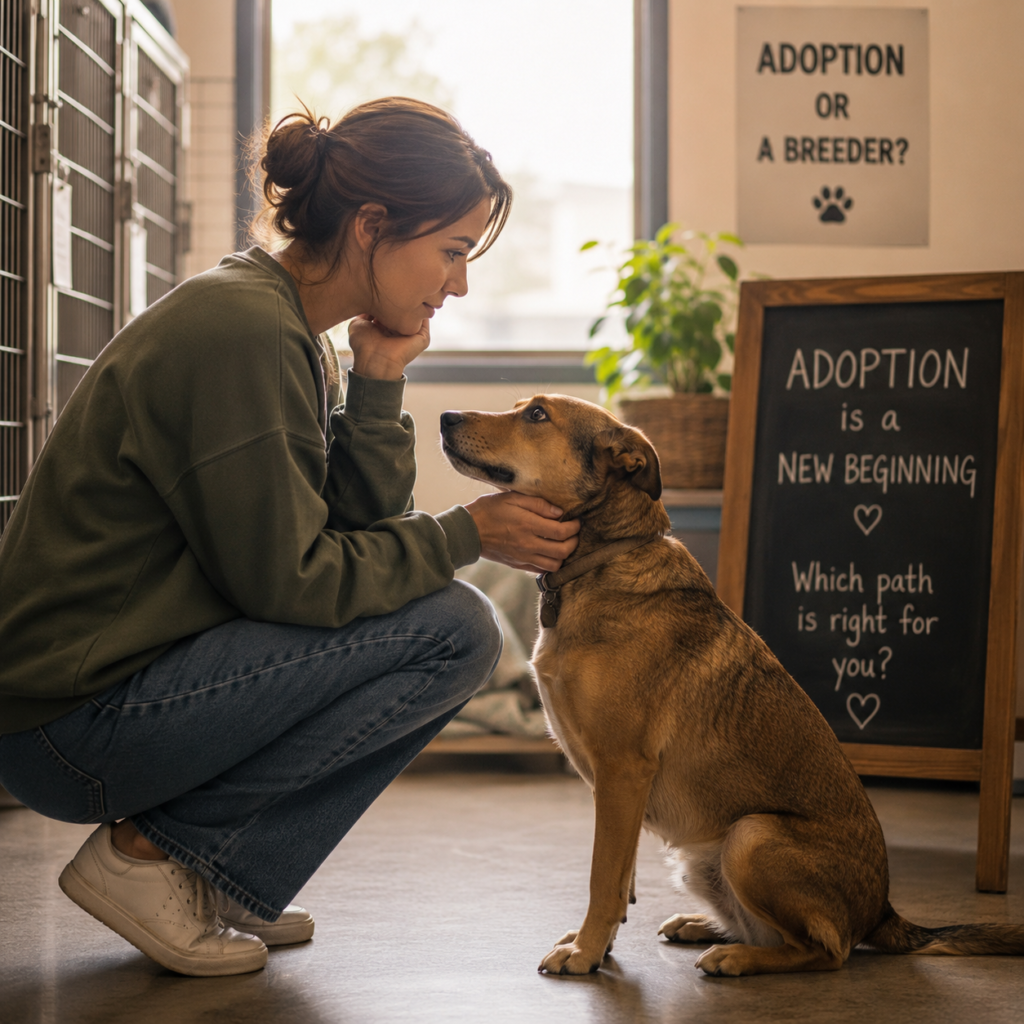
Every life with a pet starts somewhere, and long before the favorite spot in the house or the schedule you never chose but live by anyway, there’s a much earlier decision to make: adoption or a breeder.
It’s the first fork in the road, and it’s a bigger one than it looks like from the outside — not just a practical choice about where a pet comes from, but a quiet preview of the kind of relationship you’re about to build.
This is the final piece in the “Life With a Pet” series, which means it’s also, in a sense, the beginning — the decision that everything else in this series eventually grew out of.
Why Adoption or a Breeder Isn’t Just a Logistics Question
On the surface, adoption or a breeder looks like a simple comparison: cost, timing, predictability. Underneath that, it’s really a question about what kind of story you want to be part of.
A shelter dog carries a history you may never fully know. A puppy from a breeder carries a lineage you may be able to trace back for generations. Neither beginning determines what the relationship will become. They’re simply different ways for two lives to meet.
Animal welfare organizations such as the ASPCA strongly encourage prospective pet owners to consider adoption while also distinguishing responsible breeding from breeding practices that prioritize profit or volume over animal welfare. Their guidance emphasizes that responsible breeders carefully plan litters, prioritize the health and welfare of their animals, and take responsibility for the animals they produce.
What rarely gets said out loud is that this decision is also emotional, not just practical.
Some people are drawn to adoption because they want to give an animal already waiting for a home a place in theirs. Others are drawn to a breeder because they are looking for particular characteristics — temperament tendencies, adult size, coat type, working ability, or a more documented health and family history.
The important part isn’t choosing the path someone else thinks you should choose. It’s understanding what each path actually asks of you.
What Adoption Actually Involves
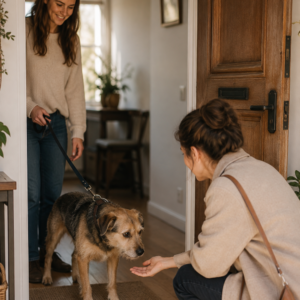
Choosing adoption usually means meeting an animal who already has a personality — sometimes clearly visible, sometimes still hidden beneath the stress of unfamiliar surroundings.
Adult shelter dogs and cats may already be house-trained, may have moved beyond the most demanding puppy or kitten stage, and may give you a clearer sense of their adult size and temperament than a very young animal can.
It also means accepting a certain amount of the unknown.
Some rescue animals arrive with detailed histories. Others arrive with almost none. And the behavior you see in a shelter or during the first days in a new home isn’t necessarily the whole picture.
An animal who seems anxious, withdrawn, restless, or unusually quiet may simply be responding to an unfamiliar environment.
A shelter pet’s first days or weeks in a new home may not show their full personality. It often emerges gradually as they begin to feel safe, understand the household routine, and realize that this place isn’t temporary.
Patience matters here.
Shelters and rescue organizations can also be valuable sources of information about the animals in their care. Staff and foster families who have spent time with a particular dog or cat may be able to tell you how that animal responds to children, other pets, strangers, being left alone, or different home environments.
That kind of observation can make finding the right match much easier.
The financial side can favor adoption as well. Adoption fees are generally lower than the purchase price of an animal from a breeder, and depending on the organization, the fee may include vaccinations, microchipping, spaying or neutering, or an initial health assessment.
What Choosing a Breeder Actually Involves
Choosing a breeder is its own kind of commitment, and choosing responsibly looks nothing like making a quick transaction.
It means research.
A responsible breeder should be willing to answer detailed questions about health testing, temperament, lineage, socialization, and the conditions in which the animals are raised. Whenever possible, prospective owners should be able to see where the animals live and learn about the parents of the litter.
The ASPCA’s guidance on responsible breeding draws an important distinction between breeders who carefully plan litters and remain responsible for the animals they produce, and commercial or irresponsible breeding practices where welfare becomes secondary to production.
Going this route also often means starting with a very young animal.
A puppy or kitten brings all the unfinished parts with them: house-training, socialization, boundaries, routines, sleepless nights, chewed objects, accidents, and the thousand tiny repetitions that eventually become good habits.
That’s a real investment of time in the early months.
But for some people, beginning at that stage is part of what they want.
Predictability is another reason people choose a breeder. Different breeds tend to come with recognizable patterns in adult size, coat type, activity level, working instincts, and certain health considerations.
Breed alone can never guarantee an individual animal’s personality or future health, but knowing an animal’s family history and breed characteristics can reduce some of the uncertainty.
For someone looking for particular traits — perhaps because of their lifestyle, living situation, allergies, sport, or a specific working role — that additional predictability can matter a great deal.
There’s also timing.
Adoption sometimes means waiting for the right match to appear: the right temperament, age, size, or type of animal arriving at a shelter or rescue at the right moment.
A responsible breeder may involve waiting too — sometimes for a planned litter or even joining a waiting list — but the process can make the likely timing of bringing a young animal home somewhat easier to anticipate.
Neither approach guarantees convenience.
Animals have a habit of ignoring the neat schedules we make for them anyway.
How People Actually Land on Adoption or a Breeder
In practice, most people don’t approach adoption or a breeder as a perfectly balanced list of pros and cons.
They arrive at one side or the other through a mixture of logic, experience, circumstance, and instinct.
Someone who has lived with a particular breed for years and understands exactly what that breed asks of them may naturally look for that breed again.
Someone else may walk into a shelter intending only to look and find themselves thinking about one particular animal all the way home.
Neither instinct needs defending.
What matters more than which path you choose is how thoughtfully you walk it.
Ask questions. Visit in person when possible. Don’t buy an animal simply because a photograph made you fall in love for thirty seconds. Don’t assume every rescue animal will be difficult, and don’t assume a pedigree makes health or temperament guaranteed.
Be honest about the amount of uncertainty you’re comfortable with — and about the amount of time, training, money, and patience you actually have.
Some people don’t firmly choose either path at first. They research breeders while also watching shelter and rescue listings, allowing the right animal rather than the category to make the final decision.
And eventually, however they arrive, one animal does.
They’re the one who’ll claim the objects around your house, establish a favorite sleeping place, learn the sound of your footsteps, and quietly rearrange the rhythm of your days.
None of that can be predicted by adoption paperwork or a pedigree chart.
Why This Decision Quietly Shapes Everything After It
This is the last article in the “Life With a Pet” series for a reason.
Every favorite spot, every claimed object, every quiet routine explored across this series started with this one decision — adoption or a breeder — even if it didn’t feel monumental at the time.
It’s easy to look back on a well-worn life with a pet and forget that it all began with a choice made somewhere.
Maybe in a shelter hallway.
Maybe in a foster home.
Maybe in a breeder’s living room.
Maybe late at night, staring at the same photograph for the twentieth time and realizing you were no longer wondering whether this animal would become part of your life, but when.
At the beginning, there are forms and questions and practical decisions.
Later, there is simply your dog.
Your cat.
Your rabbit.
Your bird.
The animal asleep in the familiar place while you move around the house without thinking about how strange it once felt to have them there.
Whichever way that first decision goes, the years that follow tend to look remarkably similar in the ways that matter most: a home reorganized around someone else’s needs, a schedule quietly built around theirs, ordinary objects that become theirs, and a silence that will eventually, someday, sound different once they’re gone.
Adoption or a breeder decides where the story starts.
Everything else in this series is what happens after.
Questions People Often Carry
Is adoption always the more ethical choice?
Adoption is widely encouraged because many animals are already waiting for homes. At the same time, responsible breeding is different from irresponsible or high-volume breeding. If you choose a breeder, careful research into health testing, living conditions, breeding practices, and the breeder’s long-term responsibility for their animals matters enormously.
How do I know if a breeder is reputable?
Ask detailed questions about health testing, lineage, temperament, socialization, and how the animals are raised. Visit in person when possible, learn about the puppy or kitten’s parents, and be cautious of anyone unwilling to answer questions or show you the conditions in which the animals live.
Is it harder to bond with an adopted pet than one from a breeder?
Not necessarily. Where an animal came from doesn’t determine how deeply they’ll eventually bond with you. Trust can develop quickly or slowly with any animal, and patience, consistency, safety, and everyday interaction usually matter far more than whether your pet came from a shelter or a breeder.
What if I want a specific breed but also want to adopt?
Those two things aren’t necessarily incompatible. Breed-specific rescue organizations exist for many popular breeds, and purebred animals can sometimes be found through general shelters and rescue groups as well. It may simply take longer to find the right match.
Every quiet year with a pet starts with one loud decision.