
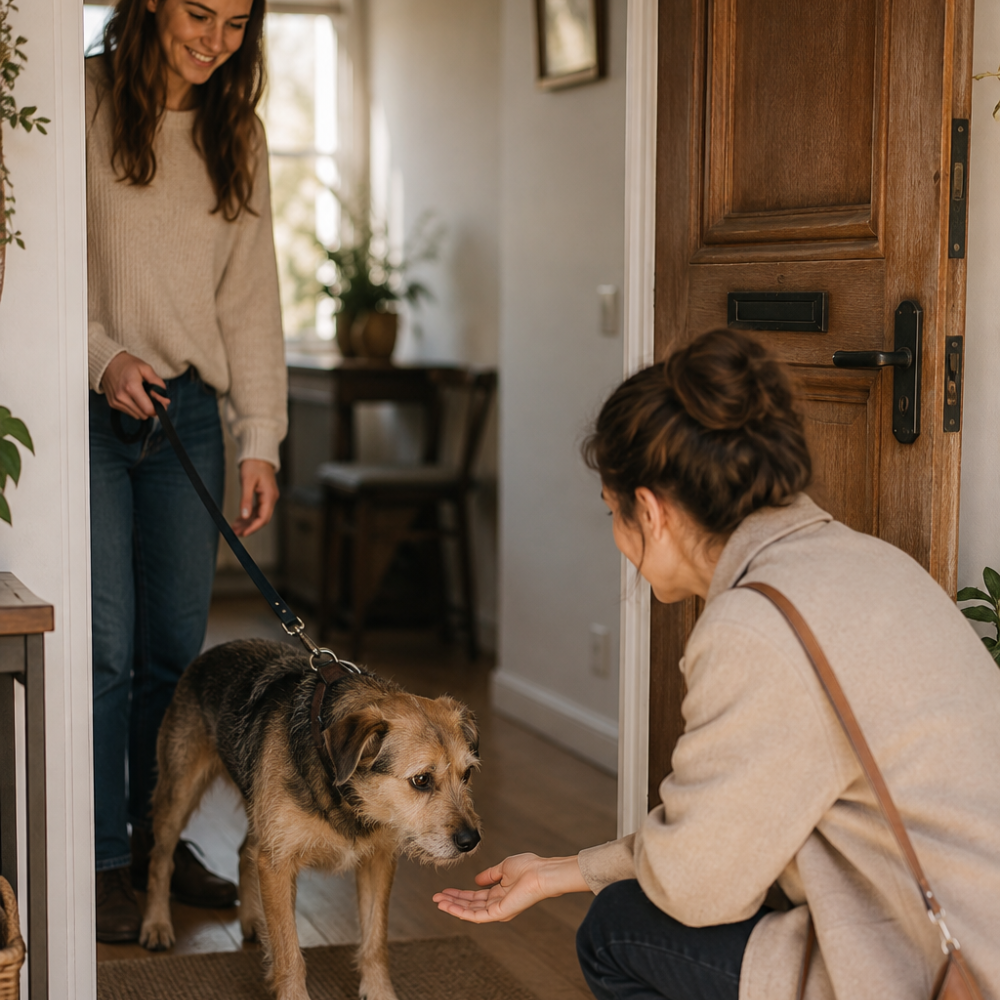
There’s a particular kind of held breath that comes just before you introduce your pet to someone new. Not panic, exactly—more like the quiet pause before a small performance you can’t completely control. You know your dog. You know your cat. Yet in that moment, you have no idea who they’re about to be.
This is one of those ordinary domestic rituals that carries far more weight than it seems to. Introducing your pet to someone new—a partner, a close friend, a parent visiting for the weekend—is never just an introduction. It’s a quiet, unspoken meeting between two relationships happening at once: the one you’ve built with the person, and the one your pet is about to begin building with them.
Why You Introduce Your Pet to Someone New So Carefully
Most people don’t think twice about welcoming a friend into their kitchen. But the moment comes to introduce your pet to someone new, and suddenly a quiet little script begins running through your mind:
Be kind. Be yourself. Please don’t choose today to become someone I’ve never met before.
Part of that feeling comes from what the moment represents. Your pet isn’t simply a pet here—they’ve become part of your home, your routines, your everyday life. The introduction isn’t only about whether two strangers will get along. It’s also about quietly revealing the life you’ve built.
A dog who can’t settle, or a cat who disappears beneath the bed, doesn’t really say anything meaningful about either of them. Yet for a moment, it can feel as though it reflects on you too. On your home. On the atmosphere you’ve created. On the version of your life you hoped someone else would get to see.
There’s another layer as well: genuine uncertainty. Even people who know their animals intimately can’t predict every first meeting, because pets respond to situations rather than scripts. A guide from Care.com on introducing dogs to new people recommends allowing the dog to approach in their own time instead of forcing interaction. In many ways, that’s simply recognizing who is really leading the meeting. The person may open the front door, but the animal decides how the introduction unfolds.
The setting matters just as much. A calm living room, where your pet already feels secure, creates a very different first meeting from a crowded hallway or a noisy gathering with nowhere to retreat. Often, the nervousness people feel beforehand says as much about the environment they’ve created as it does about the animal they’re worrying over.
What the Animal Is Actually Doing in That Moment
While you’re quietly managing your own expectations, your pet is carrying out an entirely different kind of introduction.
Dogs and cats gather information the way they’ve always done—through scent, posture, movement, tone of voice, and patience. Long before a conversation has really begun, they’ve already started deciding how this unfamiliar person fits into the world they know.
That’s part of what makes these moments feel so unpredictable. You can explain to a guest how to behave—move slowly, don’t lean over them, let the animal come first—but you can’t explain to the animal how they’re supposed to feel. Some pets approach immediately, curious and confident, as though they’ve been expecting company all day. Others prefer to watch quietly from a distance, taking their time before deciding someone new belongs in the room. Neither reaction is a judgment of the visitor. It’s simply the way that individual animal makes sense of unfamiliar situations.
Studies of canine behavior suggest that dogs form first impressions surprisingly quickly, and those early experiences often shape future interactions. A calm, patient first meeting can make later visits feel familiar much sooner, reminding us that introductions rarely end when the front door closes.
When You Introduce Your Pet to Someone New Who Matters
Not every introduction carries the same emotional weight.
Meeting the mail carrier is one thing. Introducing your pet to a new partner, a close friend, or a family member who’s seeing your home for the first time is something entirely different.
Those are the moments when you notice everything.
A dog leaning gently against someone’s leg suddenly feels meaningful. A normally cautious cat choosing to stay in the room instead of disappearing can feel oddly reassuring. Tiny behaviors take on far more significance than they probably deserve, almost as though your pet were quietly offering an opinion about someone you’ve only just begun to know.
Of course, that’s not really what’s happening. Your pet isn’t deciding whether someone deserves a place in your life. But emotionally, it can feel that way—and those feelings are real, even if the conclusions they tempt us toward aren’t.
The opposite can happen, too. A usually sociable dog staying unusually distant, or a confident cat refusing to come out, can quietly plant a seed of doubt that lingers longer than it should. Most of the time, there are perfectly ordinary explanations: unfamiliar scents, an unusual mood, an overstimulating day, or simply bad timing. Remembering that helps keep one hesitant introduction from becoming a story it was never meant to tell.
It’s also worth remembering that every pet brings their own history into moments like these. A rescue dog with an uncertain past may need much more time than an animal who’s spent their whole life feeling secure around visitors. That hesitation doesn’t tell you who the new person is. It tells you something about the journey the animal has already taken before this meeting ever began.
Letting the Introduction Happen on the Animal’s Terms
The introductions that tend to go best all have one thing in common: nobody tries to hurry them.
When an animal is given the space to approach in their own time, the meeting usually unfolds more naturally than if anyone tries to manufacture an instant friendship. Whether it’s a nervous rescue dog or a confident cat who simply prefers to observe before making up their mind, patience almost always creates a calmer beginning.
Patience changes more than just the first few minutes.
A first meeting handled quietly and without pressure often shapes everything that follows. Much like the way a pet gradually changes how you notice time, the rhythm established during those first moments often carries into every visit afterward. A good introduction isn’t the end of anything. It’s simply the beginning of familiarity.
What Happens After the First Introduction
Introducing your pet to someone new rarely settles the relationship in a single afternoon.
Most friendships between people and animals grow gradually, built across repeated visits rather than decided in one meeting. A dog who seemed distant the first time may greet that same person enthusiastically a few visits later, once their scent, voice, and presence have become part of the familiar landscape of the home.
That’s worth remembering on the days when an introduction doesn’t unfold the way you’d hoped.
One cautious meeting tells you very little about what the relationship will eventually become.
Trust is rarely built in a single afternoon—for people or for pets.
What matters far more is consistency. The same calm visitor. The same patient approach. The same willingness to let the animal decide when they’re ready. Gradually, curiosity replaces caution, and the introduction quietly stops being an event at all.
One day, you realize you no longer think of them as “someone your pet is getting used to.”
They’re simply another person your pet expects to see.
Perhaps that’s what a good introduction really is—not a perfect first impression, but the quiet beginning of familiarity.
Questions People Often Carry
Why does my dog act differently around some new people than others?
Dogs notice countless subtle details that people often miss—tone of voice, body language, scent, pace of movement, even how someone enters a room. It’s completely normal for different people to receive different reactions.
Is it normal to feel nervous introducing my pet to someone important?
Very much so. Many people experience this because the moment can feel like two important parts of their life are meeting for the first time. Even though it’s only one small moment, it often carries far more emotional weight than we expect.
Should I force my pet to interact if they seem hesitant?
No. Allowing an animal to approach at their own pace almost always leads to a calmer and more trusting relationship than encouraging interaction before they’re ready.
Does a bad first meeting mean my pet and this person won’t get along?
Not at all. First meetings are only snapshots. They often reflect unfamiliar surroundings, unusual scents, excitement, or nerves rather than any lasting judgment. Most relationships between pets and people develop gradually through repeated, positive experiences.
Maybe that’s one of the quiet truths about sharing your home with an animal. The introductions that matter most are rarely decided in a single moment. They’re built, little by little, until one day nobody remembers there was ever a first meeting at all.
An introduction is never just words. It’s a room deciding, quietly, whether it has room for someone new.