
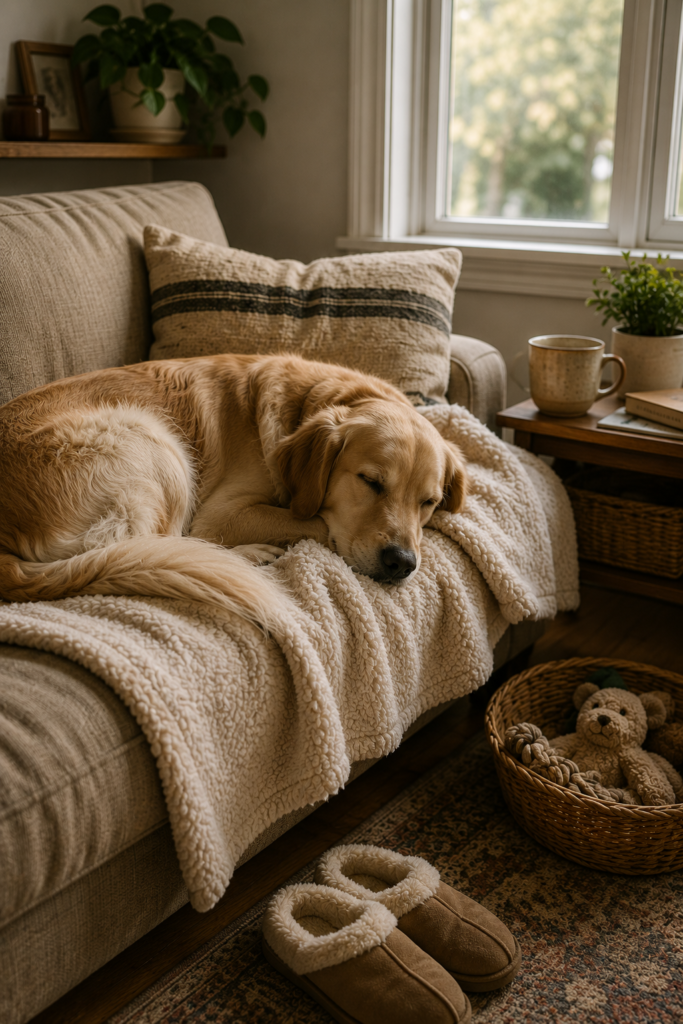
There are objects that quietly become theirs before you’ve even noticed it happening. A blanket that used to be yours. A corner of the couch that’s technically still shared, but isn’t really. A pair of slippers by the door that no longer feels safe to wear.
Nobody sits down and decides this in advance. There’s no conversation, no handover. One day a throw pillow is just a throw pillow, and a few weeks later it’s unmistakably theirs—shaped by their weight, carrying their scent, off-limits in some unspoken way even to the person who bought it. This is one of the strangest, most tender parts of sharing a home with an animal: how much of the house eventually gets sorted into “yours” and “theirs” without anyone ever drawing the line on purpose.
How Objects That Quietly Become Theirs Get Chosen
It rarely starts with a decision. An animal doesn’t sit down and choose which cushion will be theirs the way a person might. It starts as repetition—a nap here, a scratch there, a spot that happened to be warm one afternoon—and repetition is what quietly transforms a neutral object into a claimed one.
Cats are especially good at this. A cardboard box, a laundry basket, the one chair angled just right toward a window—these get chosen almost overnight and then defended with complete confidence, as if the claim had always been obvious. Dogs often build the relationship more slowly, wearing the shape of their body into a dog bed over months or deciding that one particular blanket smells enough like the family to become their favorite place in the house.
What’s interesting is how little the object’s original purpose matters. A brand-new pet bed can sit untouched for weeks while an old sweater on the floor becomes sacred territory. The objects that quietly become theirs aren’t chosen for comfort in the way we’d expect. They’re chosen for familiarity, for scent, for whatever quiet signal tells an animal, this smells like safety.
Why You Start Making Room for Them Without Noticing
At some point, you stop thinking of these objects as “borrowed” by your pet and start thinking of them as simply not yours anymore. You buy a new throw for the couch because the old one is, unofficially, a dog bed now. A certain sweatshirt stays in permanent circulation, simply because it ends up under the cat every single time you take it off. You start folding laundry around the shape of a sleeping body instead of moving it.
This shift is easy to miss because it happens through small accommodations, not big decisions. Nobody wakes up one day and formally assigns a blanket to the dog. It’s more like a slow erosion of ownership—you keep giving ground, one object at a time, until an entire section of the house quietly belongs to someone who never asked for any of it and never needs to.
There’s a kind of household logic that builds up around this, too. Certain chairs become “off-limits” chairs. A specific corner of the bed becomes reserved territory, even when the animal isn’t currently in it. People who’ve shared their favorite spot in the house with a pet will recognize this instantly. The objects that quietly become theirs are often just an extension of that same claimed space, spreading outward from a favorite spot into everything nearby.
What These Small Claims Actually Mean
It would be easy to write this off as simple territorial behavior, and biologically, some of it is. Scent marking, comfort-seeking, the instinct to claim a safe resting place—these are real and well documented. But there’s something else happening here too, something less about biology and more about relationship.
When an object becomes theirs, it usually becomes theirs because it’s near you. The blanket on your side of the bed. The chair closest to your desk. The shoes by the door you use most often. Animals tend to claim the objects that carry the most of your scent, your warmth, and your daily presence. The objects that quietly become theirs are, in a strange way, evidence of how closely they orbit you. They’re not choosing objects. They’re choosing proximity, and the objects simply become what proximity looks like.
Animal behavior research suggests that familiar scents and well-used objects help many pets feel safe when they’re separated from the people they rely on. That helps explain why losing access to a favorite blanket—through a move, a wash, or even a well-meaning cleanup—can unsettle them far more than we’d expect. It was never really about the blanket. It was about what the blanket represented: a small, physical piece of you they could keep close. You can read more about attachment-related behaviors in pets through the ASPCA Pet Health Insurance behavior guide.
Why the Objects That Quietly Become Theirs Are Hard to Take Back
There’s a particular kind of fondness that develops once you stop fighting this. You notice yourself instinctively avoiding “their” chair, not because anyone asked you to, but because it feels wrong to sit there. Explaining to a guest, half joking and half serious, that the blanket on the armchair isn’t really available for anyone else has become second nature. You’ve made peace with the fact that part of your linen closet exists purely to rotate through whatever the dog has claimed that week, and you no longer question it when someone asks why there are two “spare” blankets that never seem to be used by people.
Some people notice this most clearly when they try to reclaim something. You wash the blanket, fold it neatly, and put it back on the shelf—and within an hour it’s back on the floor, dragged into place by an animal who apparently had very strong opinions about where it belonged. Trying to “win back” a claimed object rarely works for long, not because the animal is being stubborn, but because the claim was never really about the object being available. It was about the object being theirs, and that status doesn’t disappear simply because it was tidied away.
This is what sharing a home with an animal often looks like in the small print. Not grand gestures or dramatic bonding moments, but a slow, quiet redistribution of ownership—object by object—until the house reflects both of you, not just the person who technically pays for it. The objects that quietly become theirs are one of the gentlest reminders that a home isn’t really yours alone anymore. It’s shared, in ways too small to notice until you stop and look.
Some households solve this more directly than others — giving in early with something like an orthopedic dog bed built specifically to become theirs, rather than losing the argument over the good couch cushion one inch at a time.
When Two Pets Disagree About What’s Theirs
In multi-pet households, the objects that quietly become theirs can become part of a quiet negotiation. One cushion might belong to the older cat, while the dog has claimed an entirely different chair, and both animals seem to understand the boundary without either of them ever testing it.
These arrangements can look almost diplomatic from the outside, built without a single argument that a human would recognize as one. A newer pet often starts by claiming whatever is left over—the less desirable blanket, the quieter corner—before slowly discovering, through trial and small confrontations, which objects are actually open for negotiation and which ones aren’t. Watching this unfold is its own quiet lesson in how animals communicate and how much unspoken agreement can exist inside an ordinary home.
Occasionally the claims change. An object that belonged to one pet for years is quietly adopted by another after a loss, a move, or simply changing habits. When that happens, it can feel less like coincidence and more like inheritance—as though the object itself is carrying a small piece of memory forward.
Questions People Often Carry
Why does my pet claim random objects instead of their own toys or bed?
Familiarity and scent usually matter more than comfort or design. An old sweater or well-worn blanket often carries far more of your presence than a brand-new pet bed, which is exactly why it gets chosen.
Is it a problem if my pet seems possessive over certain objects?
Mild claiming behavior—sleeping on, resting near, or gently guarding a favorite object—is completely normal. If it develops into aggression or significant distress whenever the object is moved, it’s worth discussing with a veterinarian or qualified behavior professional.
Should I try to stop my pet from taking over certain items?
Not necessarily. In most homes, it’s easier and kinder to designate a few items as theirs rather than constantly fight an instinct that isn’t going away. Offering a similar replacement usually works better than removing the object altogether.
Why does it upset my pet so much when I wash “their” blanket?
Washing removes the familiar scent that made the object feel safe in the first place. For most pets, that disruption is temporary, and the blanket gradually becomes familiar again as everyday scents naturally return.
Maybe that’s one of the quietest ways a home tells the story of everyone who lives there—not in photographs or decorations, but in the ordinary objects that slowly stop belonging to just one of you.
A home stops being only yours the moment something in it becomes theirs.