There’s a moment that catches almost everyone off guard at some point — the moment you realize your home smells like your pet in ways you’d never consciously noticed.
A blanket comes back from the dry cleaner. A jacket gets washed after months of sitting untouched. A pet stays somewhere else for a few nights.
And suddenly, something is missing that no one had consciously registered was there in the first place.
Your home smells like your pet in dozens of small, specific ways, and most of the time, none of it reaches conscious attention at all. It simply becomes part of the air, woven into fabric, carpet, and quiet corners until it stops registering as a smell and starts registering as normal.
It isn’t until that scent changes, fades, or disappears that anyone realizes it had quietly become part of what home smelled like.
Why Your Home Smells Like Your Pet Without You Noticing
Smell works differently from almost every other sense. While sound or movement quickly draws our attention, familiar scents quietly fade from conscious awareness. It’s the same reason the smell of fresh bread feels overwhelming when you first walk into a bakery but almost disappears after you’ve been there for a while.
The same thing happens at home.
The warmth of fur after an afternoon nap in the sun. The faint scent left behind on a favorite blanket. Damp paws returning from a walk. None of these smells disappear. Your brain simply stops treating them as new information because they’ve become part of everyday life.
This isn’t a sign of neglect, nor does it mean a home is dirty. It’s simply how scent adaptation works. Familiar smells become the first ones our brains quietly set aside.
In a way, not noticing your pet’s scent is a sign that it has become part of what home naturally smells like.
The Moment You Realize It Was Always There
The clearest reminder of how present that scent really is comes when it’s gone.
A dog spends a weekend at a boarding kennel, and the sofa somehow smells different.
A cat stays overnight at the veterinary clinic, and their favorite chair feels strangely neutral.
A sweater pulled from the back of a closet carries the faint scent of a pet that hasn’t been there for years.
None of these moments are dramatic. They’re quiet enough that they almost slip past unnoticed.
Yet once they happen, they tend to linger in memory.
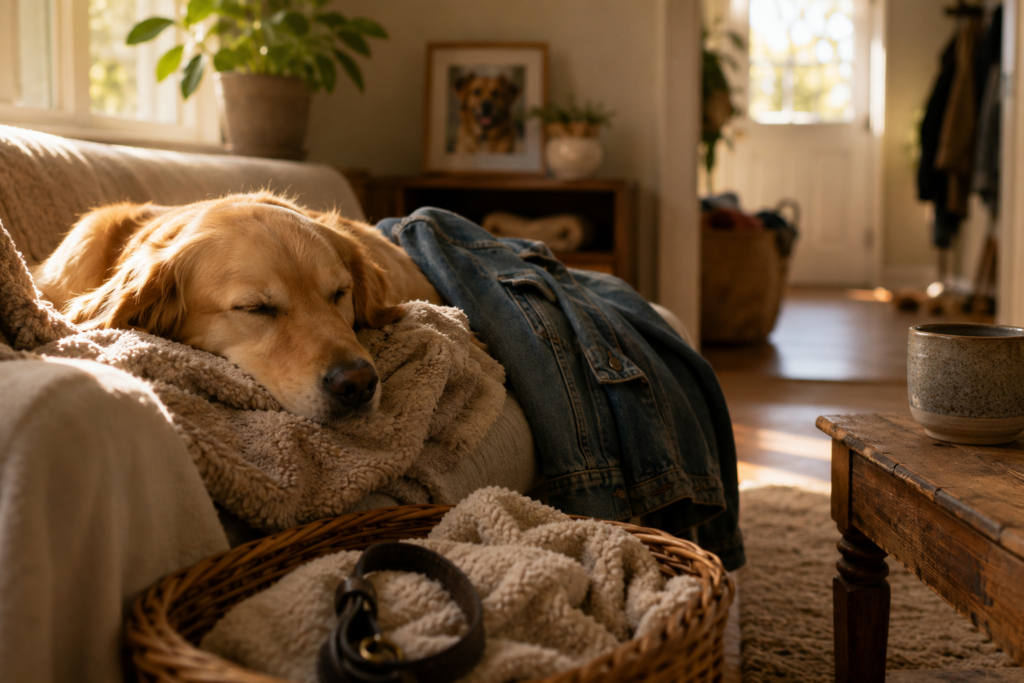
A favorite blanket.
The inside of a car.
A well-used carrier.
Without anyone intending it, these ordinary objects become small archives of scent, preserving something that no photograph could ever capture.
How Different Pets Leave Their Scent on a Home
Every animal leaves its own quiet trace.
Dogs often spread their scent through the places they spend the most time: the sofa, the hallway rug, the car after a long drive together. Their presence gradually becomes woven throughout the home.
Cats usually leave a more localized scent. A favorite windowsill. One corner of the bed. The chair they claim every afternoon. Their scent often feels tied to particular places rather than entire rooms.
Smaller pets—rabbits, guinea pigs, birds, and others—leave scents that are often connected to their enclosure, bedding, or favorite hiding places. Owners quickly come to recognize those familiar smells, even if visitors barely notice them.
Homes with more than one pet gradually develop something even harder to describe. Different scents overlap until they become part of a single atmosphere that’s unique to that particular household.
Why These Quiet Details Matter
We naturally think of memories as something we see.
We photograph birthdays, walks, and holidays.
Sometimes we record familiar sounds.
Almost no one thinks about scent.
Yet scent is one of the senses most closely connected to memory. A single familiar smell can bring back a room, a season, or a feeling with remarkable clarity.
Researchers studying <a href=”https://habri.org/” target=”_blank” rel=”noopener noreferrer”>the human-animal bond</a> suggest that familiar sensory experiences—including scent—quietly strengthen the feelings of comfort, security, and companionship that develop over years of living together.
Much like <a href=”/pets-everyday-sounds/”>your pet’s everyday sounds</a>, scent slowly disappears into the background of daily life. It isn’t gone. It has simply become part of the invisible fabric of home.
The Scent That Quietly Becomes Home
Most days, you won’t notice it.
Nor should you.
The scent of your home isn’t something meant to demand attention. It’s simply there, quietly accompanying ordinary mornings, lazy afternoons, and evenings spent together without anyone giving it much thought.
Perhaps that’s what makes these moments meaningful.
Not because we should try to preserve every scent or hold onto every blanket forever, but because they remind us how many parts of life quietly become ordinary while they’re still happening.
One day, without realizing exactly when it happened, your home simply stopped smelling like a place where a pet lives.
It started smelling like home.
Questions People Often Carry
Why don’t I notice my pet’s smell most of the time?
Our sense of smell adapts quickly to familiar scents. Once your pet’s scent becomes part of your everyday environment, your brain naturally stops drawing your attention to it unless something changes.
Is it normal to miss a specific smell after my pet has been away?
Yes. Many pet owners notice exactly this. A favorite blanket, a chair, or even the inside of a car can briefly remind them how much their pet’s scent had quietly become part of daily life.
Can I intentionally preserve my pet’s scent?
Some people choose to keep a favorite blanket, toy, or collar because it still carries a familiar scent. There’s no right or wrong approach—only what feels meaningful to you.
Do multiple pets create a different scent in a home?
They often do. Rather than one distinct smell, homes with several animals gradually develop a layered scent that’s unique to that household. Most owners couldn’t describe it in words, but they’d notice immediately if it changed.
A home doesn’t start smelling like a pet. It simply stops smelling like anywhere else.