
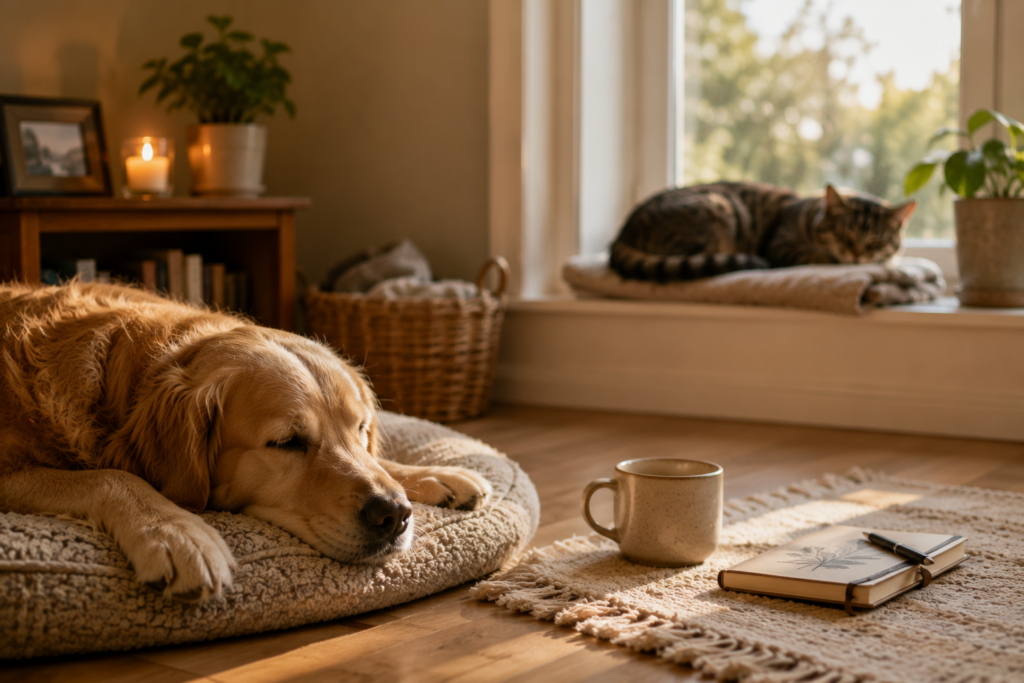
Your pet’s everyday sounds have a strange way of disappearing until they’re gone. There’s a specific kind of quiet that only shows up when a pet isn’t around, a friend watching them for the weekend, a night at the vet, or simply wandering off to another part of the house longer than usual.
It isn’t silence exactly. It’s the absence of something that had become so familiar you stopped noticing it was there in the first place.
Your pet’s everyday sounds work like that. They’re present almost constantly, noticed only occasionally, and strangely obvious the moment they disappear.
Claws clicking across hardwood. The particular exhale before settling into a nap. The soft thud of four paws landing after a jump nobody actually saw happen. The faint jingle of a collar as someone gets up to follow you into another room.
None of these feel remarkable while they’re happening. They become part of the house itself, blending into the familiar rhythm of daily life until they’re no longer sounds you consciously hear, they’re simply part of what home sounds like.
How Your Pet’s Everyday Sounds Become Part of Home
Our brains are remarkably good at filtering out familiar sounds. It’s the same reason a ticking clock seems to disappear after a while, or why people living near railway tracks eventually stop noticing the trains. Repeated sounds that don’t signal danger or demand attention gradually fade into the background.
The sounds our pets make follow that same pattern.
The rhythm of footsteps across a familiar floor. The gentle tap of a collar tag against a water bowl. A tail thumping softly against a chair leg every evening when someone comes home.
These sounds don’t become less important. They become more familiar. And familiarity has a quiet way of turning what once stood out into something that simply belongs. That shift from noticeable to ordinary is often the clearest sign that a home has truly settled around an animal.
In many ways, that’s a sign of comfort rather than inattention. Familiar sounds are often the ones that tell us, without our ever realizing it, that everything is exactly as it should be.
The Moment You Notice What’s Missing
The clearest reminder of how present these sounds really are comes when they disappear.
A pet staying somewhere else for a few days. An unexpectedly quiet afternoon. A favorite nap taking place behind a closed door instead of beside your chair.
The house doesn’t suddenly become silent.
Instead, one particular sound is missing.
The click of nails on the kitchen floor first thing in the morning.
The familiar sigh from the corner of the sofa.
The quiet shake that makes a collar jingle for just a second before settling again.
Attention has a curious habit of returning to exactly the thing it had learned to ignore the moment that thing is no longer there.
It’s often only then that people realize how deeply these ordinary sounds had become woven into the feeling of home.
How Different Pets Shape the Sound of a Home
Every animal contributes something slightly different.
Cats often bring quieter, less predictable sounds, a soft purr, the light landing after a jump from a windowsill, gentle footsteps across the hallway late at night.
Dogs tend to create a steadier rhythm: nails on hardwood, the familiar sigh before lying down, the soft jingle of a collar that announces movement before the dog itself comes into view.
Smaller pets, birds, rabbits, guinea pigs, and others, often contribute brief, distinctive sounds instead: a chirp, a squeak, the rustle of bedding being rearranged, the quiet sounds of exploring their enclosure.
Over time, people learn to recognize these sounds without thinking. They know which pet just walked into the room without looking up. They can tell who jumped off the sofa, who is drinking water, or who has decided it’s dinner time, all from sound alone.
In homes with more than one pet, these individual sounds gradually blend into something richer. A cat’s footsteps overlap with a dog’s collar, while a bird’s occasional chirp briefly cuts through both. Together, they become part of a household’s unique rhythm, a soundtrack so familiar that it’s almost impossible to notice until one part of it is missing.
One pet leaving, even temporarily, changes that rhythm more than people expect.
A dog boarded for a week. A cat staying at a friend’s place during a renovation. Suddenly there’s a gap where a sound used to be, and the remaining sounds feel slightly different too, as if the whole soundtrack shifted, not just one part of it.
It’s a small, temporary reminder of how much these sounds add up to something larger than any single noise on its own.
Why These Small Sounds Matter More Than We Realize
Your pet’s everyday sounds rarely get the same attention as a photo or a milestone, yet they often shape a home just as much.
It’s easy to think of memories as something we see rather than something we hear. We photograph birthdays, walks, and holidays far more often than we remember the everyday soundtrack that quietly accompanies them.
Yet researchers studying the human-animal bond suggest that many of the small sensory details we live alongside every day, including familiar sounds, help shape the sense of comfort, security, and companionship that develops over time.
These sounds rarely ask to be noticed.
They’re simply there, quietly accompanying ordinary days until they become inseparable from what home feels like.
This is much like the way your pet’s favorite spot in the house quietly shapes a room without anyone deciding it should. Sound does something similar. It becomes another small, familiar detail that gives a home its character.
How to Notice Your Pet’s Everyday Sounds Again
You don’t need to spend every day consciously listening for your pet.
But every now and then, it’s worth pausing for a moment.
Notice the rhythm of their breathing while they sleep.
Listen to the familiar sound of paws crossing the floor when they hear you in the kitchen.
Pay attention to the little sigh they make before settling into their favorite place.
Some of these sounds are easier to catch than others.
Feeding time usually has one. The rattle of kibble against a bowl, the specific pace of footsteps rushing toward the kitchen.
Bedtime often has one too. A long exhale. The soft weight of settling in. The particular quiet that follows once they’ve finally stopped moving.
Even a simple walk carries its own small soundtrack, nails on pavement, the jingle of a leash clip, a pause before deciding which direction to go.
None of these moments ask to be noticed. That’s exactly why they’re worth pausing for, every now and then.
Your pet’s everyday sounds don’t need to be recorded or written down to matter. But doing so, even occasionally, tends to make them easier to hold onto, long after they’ve quietly changed.
A short video. A single sentence in a journal. A moment paused instead of rushed past.
None of it needs to be perfect. It only needs to happen once in a while.
Sometimes recording an ordinary video instead of waiting for a special occasion can help preserve these sounds too. Years later, many people discover that what moves them most isn’t what they see in those recordings, but what they hear in the background.
None of this needs to become a routine or another task on a to-do list.
It’s simply an invitation to notice your pet’s everyday sounds a little more often, before they fade back into the background where they naturally belong. Years from now, it may be one of the small details you find yourself missing most, long after the more obvious moments have already faded.
Questions People Often Carry
Why do I only notice my pet’s sounds when they’re not around?
Familiar, repeating sounds naturally fade from conscious attention over time. Their absence brings them back into focus because a missing sound is often far more noticeable than one that’s constantly present.
Is it normal to miss the specific sounds my pet makes?
Yes. Many pet owners discover that they miss not only their pet’s presence but also the ordinary sounds that had quietly become part of everyday life. Those small sounds often contribute more to the feeling of home than we realize.
Can I train myself to notice these sounds more often?
You don’t have to notice them all the time. Simply pausing occasionally to listen a little more closely is often enough to appreciate the familiar soundtrack of life with your pet before it fades back into the background where it naturally belongs.
Do multiple pets create a different kind of household sound?
Yes. Homes with more than one pet tend to develop a layered soundscape rather than a single repeating pattern, each animal contributing its own footsteps, vocal habits, and small daily noises. Over time, these blend into a rhythm that feels distinct to that specific household, one that becomes especially noticeable if any single pet is ever away, even briefly.
The sounds we stop hearing are often the ones that have become part of what home feels like.