The Quiet Room That Isn’t Quiet
There is a particular kind of stillness that settles over a home in the late afternoon — when the day’s noise has faded and you find yourself in a room that feels too empty to be restful. It’s the kind of quiet that makes you aware of yourself in a way that’s not entirely comfortable.
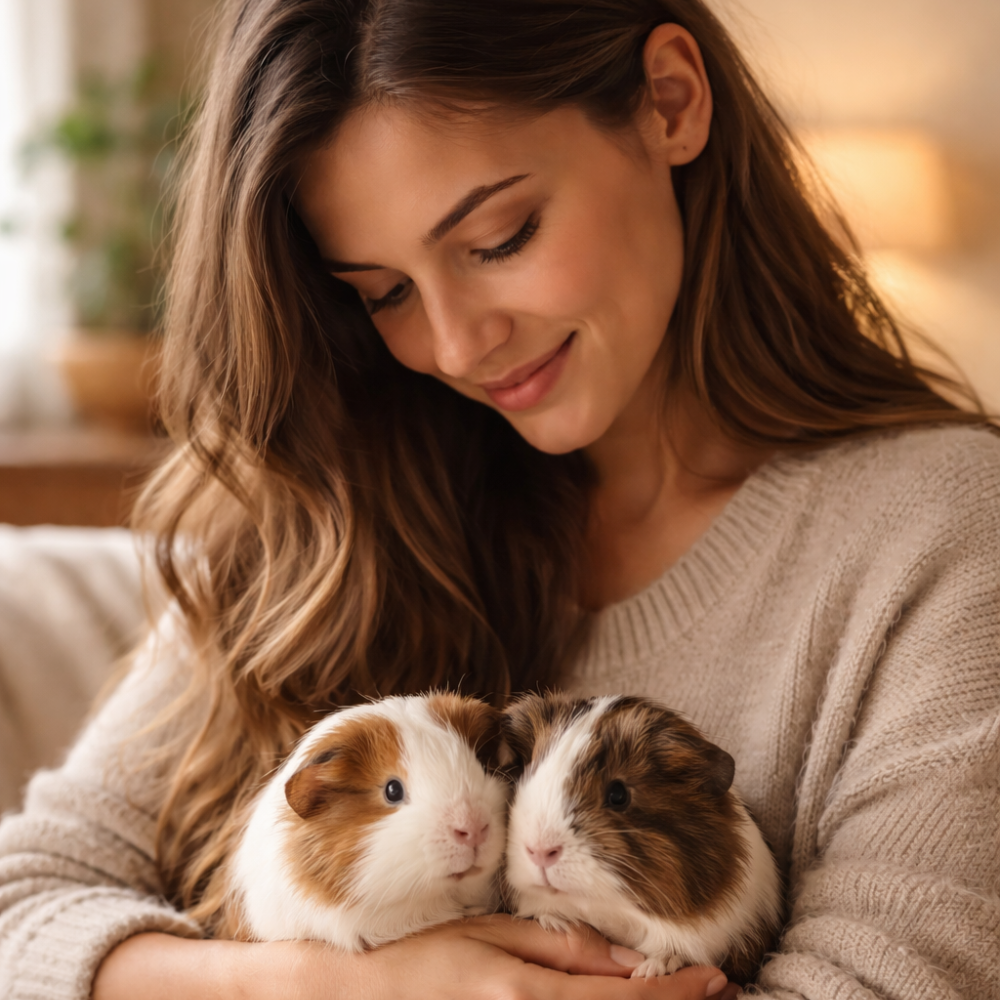
A guinea pig doesn’t fill that silence with drama. It doesn’t demand your attention with a bark or press against your leg with urgency. What it does instead is something more subtle: it simply exists alongside you. A soft rumble from across the room. A rustling in the hay. A small, unhurried sound that says, I’m here too.
If you’ve ever sat in a room that felt too quiet to be comfortable, you already understand the kind of space a guinea pig changes.
For some people, that is exactly enough. For others, it’s not quite what they were looking for — and neither answer is wrong.
Small Does Not Mean Simple
The idea that guinea pigs are an “easy” or “starter” pet tends to follow them everywhere. They are small. They don’t need walks. They fit into an apartment. They seem manageable in a way that larger animals don’t.
And in some ways, that’s true. But the category of “small pet” has a habit of making people underestimate what’s actually being asked of them.
Guinea pigs are social animals in a way that goes deeper than personality preference — it’s woven into how they are built. In the wild, they live in groups. They communicate constantly, check on each other, sleep near each other. A guinea pig kept alone doesn’t simply become independent; it often becomes quieter in a way that looks like calm but isn’t. It’s the quietness of an animal that has stopped expecting a reply.
Most people who live with pet guinea pigs and truly pay attention to them eventually notice the same thing: they need a companion of their own kind. Not a human nearby — another guinea pig.
This changes the picture. It doubles everything — the space, the food, the care, the attention. What initially seemed like a “small” commitment becomes something more present in your daily life.
Some animals don’t take up much space — but they still take up presence.
That isn’t a warning so much as an honest reframe. If you understand this from the beginning, everything that follows tends to feel right rather than surprising.
What They Actually Sound Like
Guinea pigs are among the most vocal of small animals, and this is something that often catches people off guard in the best possible way.
There’s the wheek — a high, bright sound that usually means food is near, or that they’ve heard something exciting. There’s the low, continuous purr that happens when they are content and being held gently. There’s a softer, almost conversational chatter that two guinea pigs exchange with each other, back and forth, like people discussing something unremarkable over breakfast.
If you spend long hours in a quiet space, these sounds become a kind of ambient company. You don’t have to interact. You don’t have to respond. But you are never quite alone, either.
The room has a texture to it that it didn’t have before.
For people who find silence heavy but overstimulation draining, this middle ground — the soft, steady presence of a guinea pig — can feel unexpectedly right.
The Presence That Doesn’t Push
There is a kind of connection that forms slowly with guinea pigs — almost without you realizing it’s forming.
It doesn’t happen immediately. Guinea pigs are cautious by nature. They come from a long line of animals for whom caution meant survival. Trust is not given quickly. It is extended in small, careful steps.
First, they tolerate your presence.
Then, they accept food from your hand.
Then, one day, they stay.
And when that moment arrives, it feels different.
Because it wasn’t trained.
It wasn’t asked for.
It was chosen.
The bond that forms isn’t as visible as it is with a dog. It doesn’t come with obvious excitement or constant reassurance. But it is real — and it deepens over time in a way that tends to surprise people who didn’t expect it to.
Where the Mismatch Happens
It’s worth being honest about the places where expectations and reality sometimes don’t align.
Someone who wanted an interactive pet may find guinea pigs distant. They are not particularly interested in games. They prefer the ground to being held. Being picked up is something many of them tolerate rather than enjoy.
Someone who imagined “low maintenance” may find the daily rhythm more demanding than expected. Feeding, cleaning, fresh hay, consistency — not difficult, but constant.
Someone looking for companionship may initially feel a certain distance, especially if they didn’t know guinea pigs are meant to live in pairs or small groups.
None of this means the relationship is wrong. It simply means it needs to be understood on its own terms.
The Kind of Person Who Connects Naturally
There isn’t a fixed type of person who bonds with guinea pigs — but there are patterns.
People who connect deeply with them tend to notice small things. They find meaning in subtle changes. They are comfortable with relationships that don’t rush.
They are often people who appreciate quiet routines — the steady rhythm of care, the slow unfolding of trust, the presence of something alive in the room that doesn’t demand attention but quietly holds space.
They don’t need constant confirmation to feel connected. They are comfortable with a form of closeness that builds gradually and expresses itself softly.
If any of this feels familiar, a guinea pig might fit into your life in a way that feels unexpectedly natural.
A Gentle Closing
Before you decide, there is one thing worth doing.
Not more research — that can always come later.
Just sit with the question for a moment.
Not “are guinea pigs good pets?”
But something more personal:
What kind of presence are you looking for?
What does your space feel like right now — and what would you want it to feel like?
Guinea pigs don’t ask you to become someone else.
But they do ask you to show up — gently, consistently, without rushing what takes time.
For the right person, that isn’t a compromise.
It’s exactly what they were looking for.
Questions People Often Carry
Are guinea pigs good pets for beginners?
They can be — but not because they are easy.
Guinea pigs are often described as a starter pet, and that framing tends to underestimate what they actually need. They are social animals that require daily interaction, a spacious enclosure, a consistent diet of fresh vegetables, and ideally a companion of their own kind.
What makes them good for beginners is that their needs are learnable and their temperament is forgiving.
What makes them hard is that those needs are easy to underestimate at first.
Do guinea pigs need to be kept in pairs?
For most guinea pigs, yes.
They are social animals in a way that goes deeper than preference — it is woven into how they are built.
A guinea pig kept alone doesn’t simply become independent; it often becomes quieter in a way that looks like calm but isn’t.
If you are considering a guinea pig, the more honest question is whether you are ready for two.
Are guinea pigs good pets for apartments?
Yes, if the space allows for an enclosure large enough for them to move freely — which is bigger than most people initially expect.
They don’t need outdoor access and they don’t make noise that carries through walls in the way a dog might.
What they do need is a stable environment, consistent daily care, and enough space to behave like the active, curious animals they actually are.
How much time do guinea pigs need each day?
More than their size suggests.
They need fresh vegetables and water daily, a clean enclosure maintained regularly, and time outside their enclosure to move around.
Beyond the practical tasks, they benefit from quiet companionship — someone nearby, even if not actively interacting.
The daily commitment is not intense, but it is consistent, and consistency is what they need most.
Not all presence announces itself. Some of it just settles quietly into the room — and stays.
If something in this felt familiar — or helped you see your own life a little more clearly — you’re not alone in that.
And if you’ve lived with guinea pigs, or found yourself drawn to them in a way you couldn’t quite explain, those stories tend to stay with people.
The Stories page is where those quiet, personal experiences find their place.