
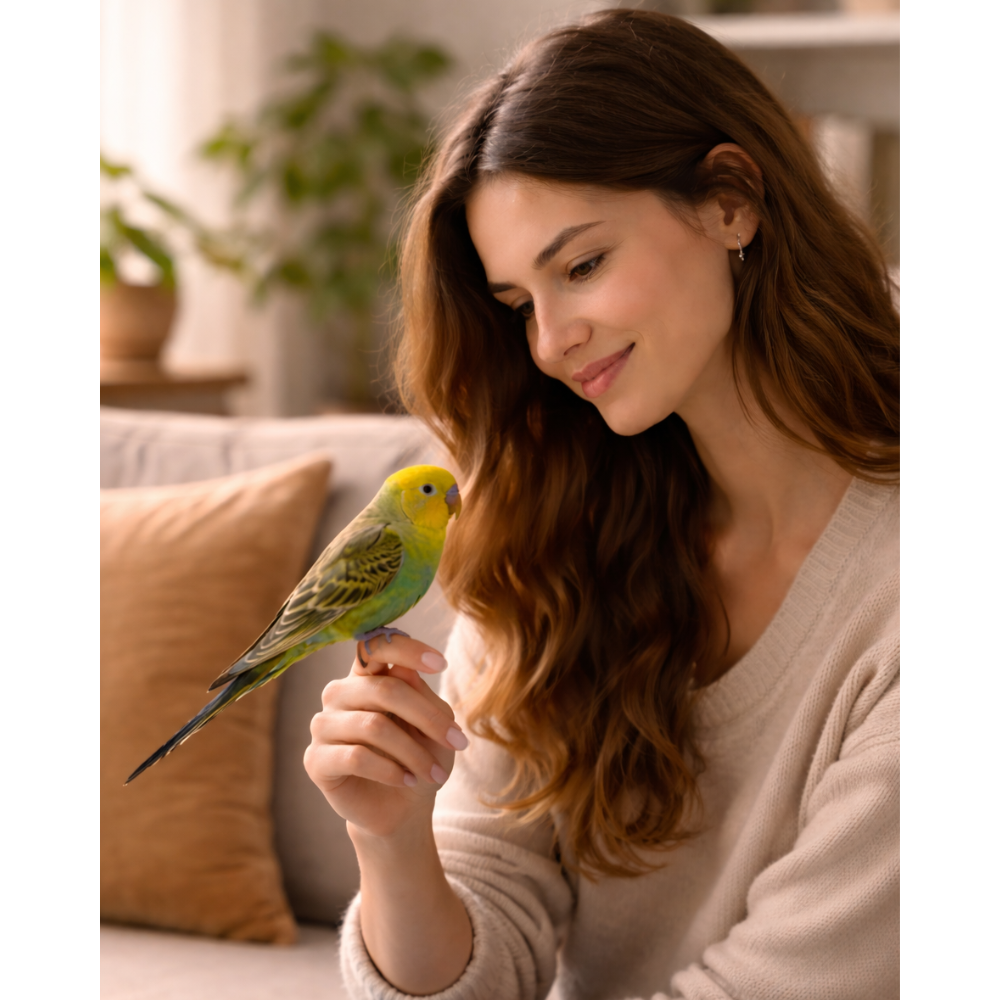
There’s a particular quality to a home that has a bird in it. It’s hard to describe until you’ve experienced it — something to do with sound, and the way sound organizes itself around a living presence. A bird changes the acoustic texture of a space. Not loudly, necessarily. Just differently. The silence that exists between a bird’s calls is a different kind of silence than the one before it arrived.
When people start asking themselves which pet is right for you, birds are often the least expected — and the most misunderstood option.
This might seem like an odd place to begin when thinking about whether a bird is right for you. But it’s actually the most honest place, because living with a bird is, more than almost anything else, about learning to share your home’s atmosphere with something that expresses itself primarily through sound, movement, and an alertness that never fully switches off.
What the Days Actually Sound Like
People who haven’t lived with birds often underestimate the auditory dimension of the relationship. This isn’t a criticism — it’s just genuinely hard to anticipate without experience. A bird doesn’t fill a room the way a dog or cat does, through weight and warmth and physical proximity. It fills a room through presence at a frequency. Through the fact that it is awake when you are awake, aware of everything that moves, and rarely entirely quiet about it.
The range is wide. A small finch or canary produces something closer to ambient sound — delicate, musical, almost background. You find yourself listening to it the way you’d listen to rain, half-consciously, aware of it mostly when it stops. A budgerigar is cheerful and chattery in a way that starts to feel conversational even without words. A parrot — depending on the species — can be a full vocal presence, mimicking, calling, demanding, narrating.
None of these is better than another. But they suit different people in different ways. The question worth sitting with is: what relationship do you have with sound in your home?
The Particular Nature of Bird Attention
Birds are observant in a way that takes a little adjusting to. They notice things — movements, changes in light, your mood, the arrival of an unfamiliar object in the room — and they respond to what they notice. You become, without quite meaning to, the most interesting thing in their environment.
Not with the devotion of a dog, and not with the quiet independence of a cat — but with something closer to active curiosity.
For some people, this is one of the most engaging parts of the relationship. A bird’s attention carries a sense of intelligence. It is not passive. It is watching, processing, responding. A tilt of the head. A shift of feathers. A sound that somehow matches the moment.
Learning this language takes time. But it rewards patience in a way that feels quietly meaningful.
Companionship Without Contact
One of the more unusual things about living with a bird is that the companionship is often non-tactile.
Some birds enjoy being handled — gently, briefly, on their terms. But for many, especially early on, the connection lives at a slight distance. They are with you. Watching you. Sharing your space. But not in your lap, not pressed against you, not in the way most people expect from a pet.
This is its own kind of intimacy.
It asks you to receive connection differently — through presence, attention, and the small moments where a bird chooses to come closer. People who find this fulfilling tend to be comfortable with quiet forms of connection. They don’t need constant feedback to feel something is real.
There is also something quietly beautiful in the fact that a bird retains a sense of wildness. Even when it knows you, even when it calls for you, it is never entirely domesticated in the way a dog is. And for some people, that matters.
The Rhythm a Bird Needs From You
Birds rely on routine more than many people expect.
They respond to light cycles, daily structure, and consistency in their environment. A life with wildly shifting hours or constant unpredictability can create stress that isn’t always visible.
They also need interaction. Not necessarily constant attention, but a sense that they are part of something — part of the room, the day, the rhythm of your life.
For someone who is present at home, even quietly, this works well. A bird doesn’t need you to entertain it every minute. It just needs to feel included.
When the Fit Feels More Difficult
If you need deep silence to think, a bird will occasionally interrupt that.
If your home is shared, or your schedule is highly irregular, the practical side of living with a vocal animal is worth considering honestly.
And if what you’re looking for is physical closeness — something warm beside you, something you can hold — a bird may leave part of that need unmet.
The relationship is real. But it arrives in a different shape.
Questions People Often Carry
Are birds good pets for beginners?
Some birds are more accessible to beginners than others.
Budgerigars and canaries are commonly recommended starting points — their care requirements are manageable and their size makes the commitment feel proportionate.
Parrots, by contrast, are often underestimated: they are highly intelligent, emotionally complex, and live for decades, which means the commitment is closer to a lifelong one than most people realize at the start.
The right question for a beginner is not which bird is easiest, but which bird’s actual needs match what you are genuinely ready to provide.
Do birds get lonely?
Many birds, particularly social species like budgerigars and parrots, do experience something that functions like loneliness when they lack sufficient company or stimulation.
They are flock animals by nature, and a bird kept alone without adequate interaction can develop stress behaviors — feather plucking, excessive calling, or withdrawal.
This doesn’t mean every bird needs a companion, but it does mean that the time and attention you offer matters more than most people expect.
Are birds noisy pets?
It depends entirely on the species.
A finch or canary produces something closer to ambient sound — musical and soft, present without being demanding. A budgerigar is cheerful and chattery. A parrot can be a full vocal presence — mimicking, calling, narrating.
None of these is better than another, but they suit different homes and different people.
Before choosing a bird, it’s worth sitting honestly with the question of what relationship you have with sound in your home.
How much attention do pet birds need each day?
More than their size suggests.
Birds are social, observant animals that notice your presence and your absence. Most birds that are kept as companions need time outside their cage every day, consistent interaction, and an environment that offers stimulation.
The commitment is not about physical care alone — it is about being present enough that the bird has a life that fits how it is built.
A bird left alone for long stretches every day, without company or enrichment, will struggle in ways that are not always obvious until they become serious.
A bird doesn’t ask to be understood. It simply goes on being itself — and in watching that, you begin to understand something about your own stillness.
Share Your Story
If you’ve ever paused at the sound of something small and alive in a room and felt, even briefly, that the space was better for it — that’s worth paying attention to.
And if you’ve lived with a bird, or remember one from another time in your life, your story belongs here too. The Stories page is where these quiet, lasting connections find their place.