
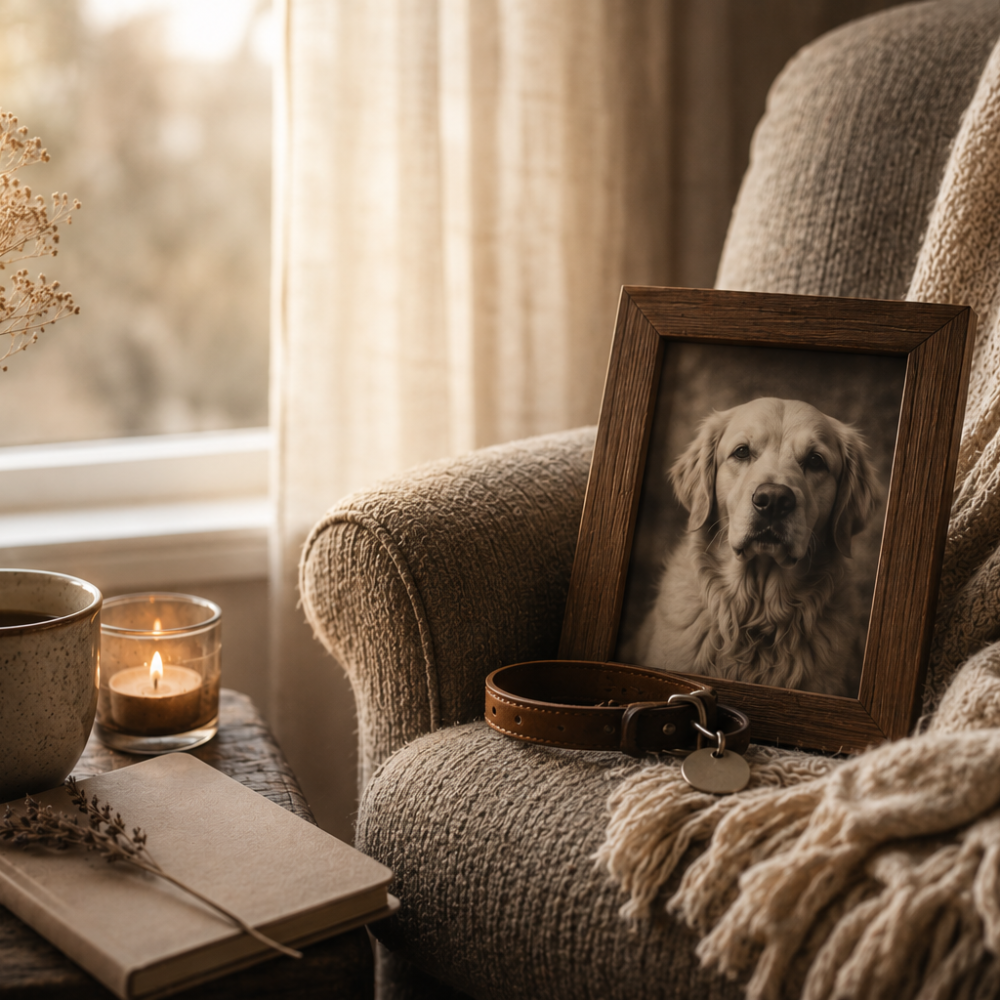
Not grand gestures. Just the quiet things that keep them close.
There is a particular fear that comes with loss — not just the grief of the present, but the fear of what comes after.
The fear that the details will blur. That the sound of their breathing, the particular way they moved, the small habits that were so familiar they went unnoticed — that all of it will slowly become less clear. That remembering will become harder than it already is.
It’s a fear that doesn’t get talked about much. But it’s one of the quieter ways grief lives in the body — in the effort to hold on, to keep the shape of who they were from dissolving into something more vague and general.
Keeping a pet’s memory doesn’t require anything formal. It doesn’t require a ceremony, or a monument, or the right words at the right time. It only requires intention — small, consistent acts that say: this mattered, and I am not going to let it disappear.
Write down the details while they’re still clear
Memory is not a photograph. It shifts over time — the edges soften, the specifics blur first, the emotional weight remains long after the texture has faded. The things that feel impossible to forget right now are often the ones that are hardest to recall two years from now.
This is not a failure of love. It is simply how memory works.
What helps is writing things down while they’re still vivid. Not a formal tribute — just notes. The sound they made when they were happy. The way they slept. Their favorite spot in the house and why it was theirs. The small things they did that you never quite understood but always found endearing. The words you used with them that you wouldn’t use with anyone else.
These details are not small. They are the texture of who they were. And once they’re written down, they don’t have to rely on memory alone to survive.
The Pet Memory Journal was made for exactly this — a quiet place to keep the details before they blur.
Let one object hold the weight
There is something human about wanting a physical thing to hold grief.
Not because an object replaces what was lost — nothing does — but because having somewhere to put it, something to touch, can make the loss feel less formless.
It doesn’t have to be elaborate.
A collar kept in a drawer.
A photograph in a frame that stays in the same place.
A blanket that still carries something of their presence.
A plant in a corner of the garden.
A small stone with their name.
The object matters less than the intention behind it.
What you’re doing, when you choose one thing to hold the memory, is giving grief a home — a place it can live without having to fill every corner of the house.
Keep the rituals that were theirs
Every life shared with an animal develops its own rituals.
The morning walk.
The evening check-in.
The specific chair they claimed.
The moment at the end of the day when the world got smaller and quieter and it was just the two of you.
When they’re gone, those rituals don’t have to go with them.
Some people continue the morning walk alone, or with someone else. Some keep the same chair empty, or repurpose it in a way that feels right. Some continue to speak aloud in the moments they used to share — not because they expect an answer, but because the habit of that presence was woven into the shape of the day, and some habits take time to let go of, and that is allowed.
Continuing a ritual is not the same as being unable to move on.
It is a way of honoring what was real, and real things deserve to be honored.
If you’re still in the early days of loss, The First Days After Losing a Pet might help you find your footing.
Create something, if that feels right
There is no single right way to keep a memory.
Some people find that making something — a photo album, a memory box, a written piece about who they were — gives the grief somewhere to go. The act of making becomes an act of remembering, deliberate and careful.
Others find that the most meaningful thing is simply to talk about them — to say their name in conversation, to tell stories, to let the people around them know that this animal existed and mattered and left a mark.
And some find that what they need is quieter than any of that. A moment each day. A thought. A feeling of gratitude for what was shared, however long or brief.
None of these is more correct than the others.
The only thing that matters is that the approach feels true to who they were and who you are.
Let the memory live in ordinary time
The best memorial, in the end, is not a single moment or object.
It is the way a life shared with an animal quietly changes you — the patience it built, the presence it required, the particular quality of attention that comes from loving something that cannot use words.
Those things don’t leave when they do.
They stay in the way you move through the world, in the habits you carry, in the capacity for that kind of love that doesn’t diminish just because its object is gone.
Keeping their memory is not about holding on so tightly that grief becomes weight.
It is about finding the ways they are still here — in what they taught you, in what changed because of them, in the love that has nowhere to go now and so finds small quiet places to live.
If you’re wondering whether any of this gets easier, Is It Normal to Grieve This Much for a Pet? might offer some comfort.
Questions People Often Carry
Was it too soon to start keeping mementos after losing a pet?
There is no too soon.
Reaching for something to hold onto in the early days of loss is not avoidance — it is instinct. The impulse to keep a collar, a photo, a blanket is the impulse to honor what was real.
Follow it whenever it comes.
What is the best way to keep a pet’s memory alive?
There is no single best way — only the way that feels true to who they were and who you are.
For some people it is writing; for others it is a physical object, a continued ritual, or simply saying their name.
The details blur first, so capturing them early — in a journal or written notes — tends to help the most over time.
How do I keep from forgetting the details about my pet?
Write them down while they are still vivid.
Not a formal tribute — just notes. The specific sounds, habits, phrases you used with them, the way they moved.
Memory softens over time and the details go first. Whatever you write down now will still be there years from now, when memory has become only feeling.
Is it okay to keep my pet’s belongings after they die?
Yes — completely.
Keeping a collar, a bed, a favorite toy is not morbid or unhealthy. It is one of the ways people hold onto the texture of who their pet was.
There is no timeline for when those objects should be moved or given away.
Keep them for as long as they bring comfort.
The details blur, but the shape of love doesn’t. What they left behind lives in the way you learned to pay attention.
If you’d like to keep the details close — the ones that blur first, before memory becomes only feeling — the Pet Memory Journal was made for exactly that.
And if you’d like to share who they were, there’s space for it at Horizon Memory.


